









Newsletters
Subscribe to our newsletter and get statistical data as soon as it is available!...
Regional Directorate of Statistics of Madeira releases the first results of the Fertility Survey, carried out in 2019, for the Autonomous Region of Madeira
The Regional Directorate of Statistics of Madeira (DREM) releases today the first results of the Fertility Survey (IFEC), a sample survey carried out in the Autonomous Region of Madeira (ARM) between September 2019 and February 2020, in 1,231 households. The IFEC - survey conducted by Statistics Portugal (INE) - took place across the country, with DREM being responsible for its execution in the ARM.
Similar to the last Fertility Survey, carried out in 2013, this operation aimed to obtain detailed information on the phenomenon of fertility in Portugal, informing about the number of children that people have, expect or desire to have throughout their lives, and the reasons that determine the decision to have or not (more) children.
The information released today about the Region concerns women in childbearing ages, 18 to 49 years old, since at the NUTS II level the sample collected is only representative for the female population.
Women living in the Region are far from achieving their desired fertility throughout their life
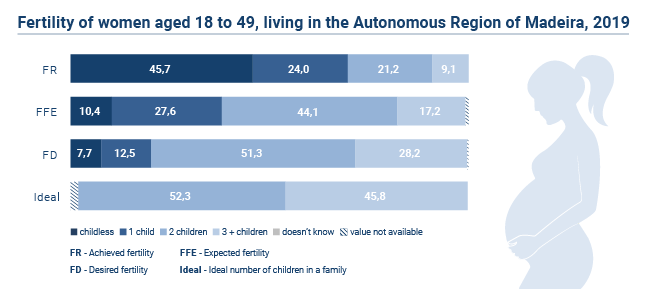
61.3% of women in childbearing ages expect to have at least two children and 79.5% desire two or more children in their lifetime. However, the vast majority is childless (45.7%) or has only one child (24.0%).
Although only 30.3% of women actually have 2 or more children, the overwhelming majority (98.1%) considers 2 or more children to be the ideal number of children in a family (regardless of their own). In the context of NUTS II regions, the women living in the A. R. Madeira report the highest “ideals”, 2.60 children, on average.
Among women aged 18 to 49, 10.4% do not have nor intend to have children (8.4% in Portugal).
Currently, women between 18 and 49 years old do not have 1 child on average (0.96 children in the A. R. Madeira and 0.98 in Portugal), however they expect to have on average 1.74 children (1.75 in Portugal) and desire 2.14 children on average (2.19 in Portugal).
The first results show that between “desire” and “reality” there is a significant gap, since women living in the Region are still far from reaching their desired fertility throughout life.
DREM will soon release more information about IFEC
Later this year, DREM will release more results on this survey, which will include an analysis of fertility according to different profiles, as well as an analysis of women's fertility motivations and their opinions on measures that could encourage woman to have more children.
For more information, please click on:
International Statistical Cooperation
 |
International Statistical Cooperation
|
Statistical Literacy
 |
Statistical Literacy
|
|
|
|
|
 |
 |
|



 |
|
|
 |

Copyright © 2026 Direção Regional de Estatística da Madeira. All rights reserved.
Address: Calçada de Santa Clara 38, 9004-545 Funchal, Madeira Island
Phone: +351 291 145 110 (National landline call)