









Newsletters
Subscribe to our newsletter and get statistical data as soon as it is available!...
Children's Day
To commemorate Children's Day, the Regional Directorate of Statistics of Madeira (DREM) is releasing a special "In Focus" today, providing a characterisation of children residing in the Autonomous Region of Madeira (ARM) in 2021. This analysis is based on the results of family structures from the XVI General Population Census and VI General Housing Census (Census 2021), as well as on education statistics provided by the Education Observatory of the Autonomous Region of Madeira (OERAM). Additionally, information on the number of births that occurred between 2007 and 2021 is used to assess behavioural changes among generations of parents of children born in the Region.
Based on the extensive analysis conducted by DREM, the following key points emerge:
1.37 children per family with children in 2021
According to the 2021 Census, the Autonomous Region of Madeira had a total of 94,844 private households and 74,077 family units. Among these family units, 31.1% (23,033 units) included children aged 0-14.
The majority of family units with children were composed of couples (75.9%), while 24.1% were single-parent households.
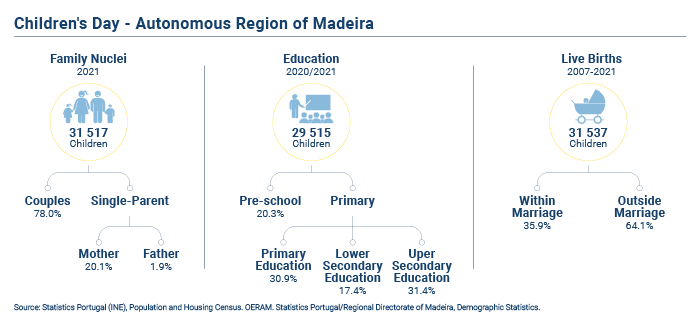
The Census recorded a total of 31,517 children in family units. Among these children, 78.0% were part of couple households, 20.1% belonged to single-parent households led by mothers, and 1.9% were in single-parent households led by fathers.
On average, there were 1.37 children per family with children in the Region.
Married couple households had a slightly higher average number of children (1.42 children) compared to unmarried couples (1.36 children).
Furthermore, single-parent households led by mothers had a higher average number of children (1.26 children) compared to single-parent households led by fathers (1.17 children).
In couple households where the highest educational attainment was up to the basic level, the average number of children was lower (1.39 children) compared to couple households with higher education (1.50 children).
In 2020/2021, 6,003 children were enrolled in pre-school education, 9,130 in primary education (1st cycle), 5,122 in lower secondary education and 9,260 in upper secondary education
In the 2020/2021 school year, the ARM had a total of 6,003 children enrolled in pre-school education, 9,130 in primary education, 5,122 in lower secondary education, and 9,260 in upper secondary education. The majority of these students attended public schools.
The gross enrolment rate for pre-school education in the Region was 102.3%, indicating that the number of children enrolled in pre-school education exceeded the resident population aged 3 to 5 years.
For primary education, the gross enrolment rate was 113.0% in the same school year. This means that approximately 113% of the resident population within the normal age range for primary education (6 to 14 years) was enrolled in primary education, lower secondary education, or upper secondary education.
The gross enrolment rate was highest in upper secondary education, reaching 114.6%, followed by primary education with a rate of 113.5%, and lower secondary education with a rate of 109.2%.
The transition/completion rate in primary education, which represents the proportion of students who successfully completed the school year compared to the total number of students enrolled in primary education, was 97.2%.
In primary education, the transition/completion rate was 98.2%, in the lower secondary education it reached 98.5%. In upper secondary education, the transition/completion rate was slightly lower at 95.3%.
Between 2007 and 2021, 31,537 children were born to older and more educated parents compared to previous decades
Between 2007 and 2021, a total of 31,537 live births were recorded in the ARM, with 51.1% being boys and 48.9% being girls.
In the majority of births (93.0%), both parents were of Portuguese nationality, while in 4.2% of cases, one parent was a foreigner, and in 1.5% of cases, both parents were foreigners.
There has been a decline in fertility over these 15 years, with the number of births decreasing from 2,718 in 2007 to 1,744 in 2021.
The average age of mothers at childbirth has increased from 29.7 years in 2007 to 32.3 years in 2021. Additionally, the average age of mothers at the birth of their first child has increased from 27.9 years to 30.8 years.
There has been an increase in the proportion of births outside of marriage, rising from 29.4% in 2007 to 64.1% in 2021.
Regarding the educational level of parents, there has been a decrease in the proportion of births to parents with basic education and an increase in the proportion of births to parents with higher education.
For more information, please click on:
International Statistical Cooperation
 |
International Statistical Cooperation
|
Statistical Literacy
 |
Statistical Literacy
|
|
|
|
|
 |
 |
|



 |
|
|
 |

Copyright © 2026 Direção Regional de Estatística da Madeira. All rights reserved.
Address: Calçada de Santa Clara 38, 9004-545 Funchal, Madeira Island
Phone: +351 291 145 110 (National landline call)