








Newsletters
Subscribe to our newsletter and get statistical data as soon as it is available!...
DREM joins the 88th anniversary of Statistics Portugal with a special " In Focus" on Family Structures in the Autonomous Region of Madeira.
Today, on May 23, 2023, to commemorate the 88th anniversary of Statistics Portugal (INE), the Regional Directorate of Statistics of Madeira (DREM) – which operates as a delegation of Statistics Portugal, as stipulated by the Law of the National Statistical System – joins the celebration by sharing information on family structures in the Region, using the final results of the 2021 Census.
Based on the analysis conducted by DREM, several key points emerge regarding family structures in the Autonomous Region of Madeira:
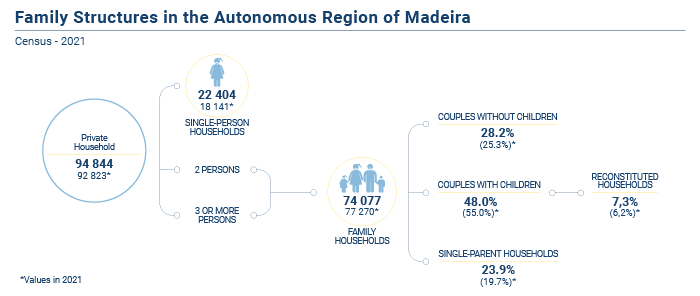
- The Autonomous Region of Madeira registered a total of 94,844 private households.
- This figure represents a 2.2% increase compared to the number of private households recorded in the 2011 Census.
- The average size of private households decreased from 2.9 persons in 2011 to 2.6 persons in 2021.
- Single-person private households accounted for 23.6% of the total number of private households (19.5% in 2011).
- Single-person private households of persons aged 65 or older accounted for 10.9% of the total number of private households (8.3% in 2011).
- The majority of single-person private households were composed of women (61.6%), aged 65 or older (57.2%), retired (52.5%), with education up to the lower secondary education (69.4%).
- The majority of family nuclei consisted of households with children, with 48.0% being couples with children and 23.9% being single-parent households. Couples without children accounted for 28.2% of the total.
- The average number of children (including those under 15 years old) per couple with children decreased between 2011 and 2021.
- The average number of children per couple was higher when both members of the couple were employed or had a higher level of education.
- The proportion of single-parent households headed by a mother with children (86.9%) was higher than those headed by a father with children (13.1%).
- The average number of children per single-parent household was higher when the father or mother had a higher level of education.
For more information, please click on:
International Statistical Cooperation
 |
International Statistical Cooperation
|
Statistical Literacy
 |
Statistical Literacy
|
|
|
|
|
 |
 |
|



 |
|
|
 |

Copyright © 2026 Direção Regional de Estatística da Madeira. All rights reserved.
Address: Calçada de Santa Clara 38, 9004-545 Funchal, Madeira Island
Phone: +351 291 145 110 (National landline call)