










Newsletters
Subscribe to our newsletter and get statistical data as soon as it is available!...
In 2024
Number of persons at risk of poverty or social exclusion decreased, while the median housing cost burden increased
The Regional Directorate of Statistics of Madeira (DREM) has today released a new set of data from the 2024 Survey on Income and Living Conditions (EU-SILC), supplementing the information published at the end of last year.
Based on the national poverty threshold, approximately 48.9 thousand residents in the Autonomous Region of Madeira (ARM) were at risk of poverty in 2023, representing a 22.1% decrease compared with the previous year. This corresponds to an at-risk-of-poverty rate of 19.1%, down by 5.7 percentage points (pp) from 2022 (24.8%), although still above the national average (16.6%, a decrease of 0.4 pp compared with 2022). Among employed persons aged 18 and over, 12.6 thousand were at risk of poverty in 2023. This figure reflects a reduction of 5.8 thousand workers compared to 2022, corresponding to an at-risk-of-poverty rate of 10.3% (compared to 9.2% nationally).
In 2023, approximately 11.3 thousand persons were living in households with very low work intensity per capita, reflecting a 24.2% decrease from 2022. The proportion of the population under 65 living in such households stood at 5.6%, a reduction of 1.8 pp compared to the previous year. Nevertheless, this indicator remained above the national average of 4.8%.
For 10 out of the 13 items that constitute severe material and social deprivation, 2024 data show a decline in the proportion of persons affected by most limitations due to economic hardship, compared with 2023. Among the main reported difficulties were, at the household level, the inability to replace worn-out furniture (47.0%), and at the personal level, the inability to regularly participate in leisure activities such as sports, cinema, or concerts (10.3%).
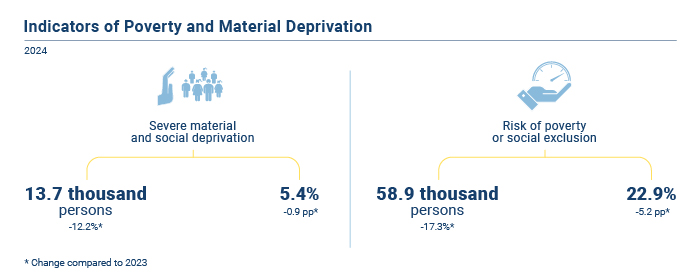
It is estimated that 13.7 thousand persons in the Region were experiencing severe material and social deprivation in 2024, 1.9 thousand fewer than in the previous year, representing a 12.2% reduction. The corresponding rate in the ARM was 5.4% (6.3% in 2023). Nationally, this rate stood at 4.3% (4.9% in 2023).
In 2024, approximately 58.9 thousand residents were at risk of poverty or social exclusion, 12.3 thousand fewer than in 2023 (a decrease of 17.3%). The at-risk-of-poverty or social exclusion rate in the ARM was 22.9%, a reduction of 5.2 pp compared to 2023 (nationally: 19.7%, down 0.4 pp from 2023).
Although the available time series for the various indicators mentioned above is relatively short, it is noteworthy that, in all cases, the recorded values represent the lowest levels in the series.
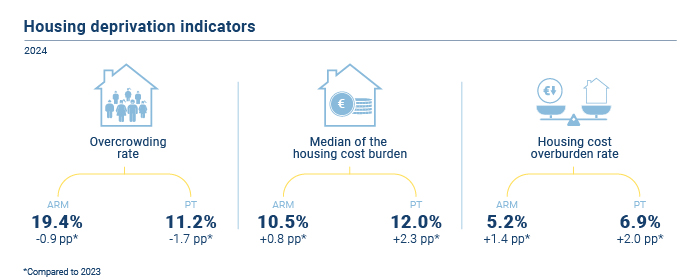
With regard to housing deprivation indicators, the overcrowding rate stood at 19.4% in 2024 (20.3% in 2023), remaining, however, above the national average of 11.2%.
An increase was observed in the ratio between housing costs and household disposable income, with the median housing cost burden in 2024 standing at 10.5% (compared with 9.7% in 2023), below the national figure (12.0%). The housing cost overburden rate was 5.2% (3.8% in 2023), also below the national level (6.9%). Finally, the severe housing deprivation rate stood at 10.3%, representing a reduction of 3.1 pp and converging towards the national average (4.9%, down 1.1 pp from 2023).
For more information, please click on:
International Statistical Cooperation
 |
International Statistical Cooperation
|
Statistical Literacy
 |
Statistical Literacy
|
|
|
|
|
 |
 |
|



 |
|
|
 |

Copyright © 2026 Direção Regional de Estatística da Madeira. All rights reserved.
Address: Calçada de Santa Clara 38, 9004-545 Funchal, Madeira Island
Phone: +351 291 145 110 (National landline call)