










Newsletters
Subscribe to our newsletter and get statistical data as soon as it is available!...
Statistical Indicators
- Resident Population
- Natural Balance
- Unemployment
- GDP
- RIEAI
- Inflation
- Overnight Stays
- Dwelling Sales
- Companies
|
Resident Population Resident Population Estimates (31 December). |
|
2025, Resident Population Estimates based entirely on administrative data. 2021 - 2024, Revised Resident Population Estimates following the compilation of the 2025 Resident Population Estimates, based entirely on administrative data. Source: Statistics Portugal/DREM - Demographic Statistics |
|
Unemployment Rate Quarterly rate obtained from the Labour Force Survey, corresponding to the ratio of the unemployed population to the active population (%). |
|
Source: Statistics Portugal/DREM - Labour Force Survey |
|
Inflation Rate Average Rate of Change over the last 12 months of the Consumer Price Index (%). |
|
Source: Statistics Portugal/DREM - Consumer Price Index |
|
Overnight Stays Overnight stays recorded in total collective tourist accommodation (thousands). |
|
Source: Statistics Portugal/DREM - Tourism Statistics |
|
GDP Gross Domestic Product (GDP) of the Autonomous Region of Madeira at current prices, base 2021 (million euros). |
|
The value for 2024 is provisional. Source: Statistics Portugal - Regional Accounts (Base 2021) |
|
Family Dwelling Sales Number of Family Dwelling Sales (Total, New and Existing) in the Autonomous Region of Madeira. |
|
Source: Statistics Portugal (INE, IP.). |
|
Company Incorporation and Dissolution Number of companies incorporated and dissolved. |
|
Source: Directorate-General for Justice Policy |
|
Natural Balance Difference between the number of live births and the number of deaths in a given period of time (No.). |
|
* Preliminary data compiled up until November 6th 2026. Source: Statistics Portugal/DREM - Demographic Statistics |
|
Regional Indicator of Economic Activity 3-month moving average (%). |
|
Source: DREM |
Statistical Indicators
|
Population Resident Population estimates by the 31st of December. |
|
2025, Resident Population Estimates based entirely on administrative data. 2021 - 2024, Revised Resident Population Estimates following the compilation of the 2025 Resident Population Estimates, based entirely on administrative data. Source: INE/DREM - Demographic Statistics |
|
Unemployment Rate Quarterly rate derived from the Labour Fource Survey, which corresponds to the ratio between the unemployed and the active population(%). |
|
Source: INE/DREM - Labour Force Survey |
|
Inflation Rate 12-month average growth rate of the Consumer Price Index. |
|
Source: INE/DREM - Consumer Price Index |
|
Overnight stays Overnight stays in tourism accommodation (thousands). |
|
Source: INE/DREM - Tourism Statistics |
|
GDP Gross Domestic Product (GDP) of the Autonomous Region of Madeira at current prices, base 2021 (millions of euros). |
|
The value for 2024 is provisional. Source: INE - Regional Accounts (Base 2021) |
|
Dwelling Sales Number of Dwelling Sales (Total, New e Existing), in the Autonomous Region of Madeira. |
|
Source: Statistics Portugal |
|
Formation and Dissolution of Companies Number of formed and dissolved companies. |
|
Source: Directorate-General for Justice Policy |
|
Natural Change Balance between the number of live births and the number of deaths in a given time period (No.). |
|
* Preliminary data compiled up until November 6th, 2026. Source: INE/DREM - Demographic Statistics |
|
Regional Indicator of Economic Activity 3-month moving average (%). |
|
Source: DREM |
Publications
-

Annual publication
Price: papel - 3,50 € / PDF - Free
Year of publication: 2024
Reference period: 2023
Quarterly Bulletin of Statistics
Quarterly publication
Price: paper - 4,00 € / PDF - Free
Year of publication: 2025
Reference period: 2nd Quarter 2025
-
Annual publication
Price: paper - 22,00 € / PDF - Free
Year of publication: 2024
Reference period: 2023

Census - Final results: Autonomous Region of Madeira - 2021
Annual publication
Price: paper - 10,00 € / PDF - Free
Year of publication: 2023
Reference period: 2021
-

Annual publication
Price: PDF - Free
Year of publication: 2026
Reference period: 2025
Monthly publication
Price: paper - 3,00 € / PDF - Free
Year of publication: 2025
Reference period: December 2024
-
Annual publication
Price: paper - 10,00 € / PDF - Free
Year of publication: 2024
Reference period: 2023

Annual publication
Price: paper- 12,00 € / PDF - Free
Year of publication: 2026
Reference period: 2024
-

International Trade Statistics
Annual publication
Price: paper- 6,00 € / PDF - Free
Year of publication: 2021
Reference period: 2020

Quarterly publication
Price: paper- 2,00 € / PDF - Free
Year of publication: 2025
Reference period: 4th Quarter 2024
-

Annual publication
Price: paper - 4,00 € / PDF - Free
Year of publication: 2024
Reference period: 2023

Agriculture and Fishery Statistics
Annual publication
Price: paper - 3,50 € / PDF - Free
Year of publication: 2024
Reference period: 2023
-

Annual publication
Price: paper - 12,00 € / PDF - Free
Year of publication: 2021
Reference period: 2019

Construction and Housing Statistics
Annual publication
Price: paper - 4,50 € / PDF - Free
Year of publication: 2024
Reference period: 2023
Publications
-
Annual publication
Price: paper - 3,50 € / PDF - Free
Year of publication: 2024
Reference period: 2023
-

Annual publication
Price: paper - 22,00 € / PDF - Free
Year of publication: 2023
Reference period: 2022
-

Monthly publication
Price: paper - 1,50 € / PDF - Free
Year of publication: 2025
Reference period: May 2025
-
Annual publication
Price: paper - 10,00 € / PDF - Free
Year of publication: 2024
Reference period: 2023
-
International Trade Statistics
Annual publication
Price: paper - 6,00 € / PDF - Free
Year of publication: 2021
Reference period: 2020
-
Annual publication
Price: paper - 4,00 € / PDF - Free
Year of publication: 2024
Reference period: 2023
-
Annual publication
Price: paper - 12,00 € / PDF - Free
Year of publication: 2021
Reference period: 2019
-
Quarterly Bulletin of Statistics
Quarterly publication
Price: paper - 4,00 € / PDF - Free
Year of publication: 2025
Reference period: 2nd Quarter 2025
-
Census - Final results. Autonomous Region of Madeira - 2021
Annual publication
Price: paper - 10,00 € / PDF - Free
Year of publication: 2023
Reference period: 2021
-
Construction and Housing Statistics
Annual publication
Price: paper - 4,50 € / PDF - Free
Year of publication: 2023
Reference period: 2022
-
Agriculture and Fishery Statistics
Annual publication
Price: paper - 3,50 € / PDF - Free
Year of publication: 2024
Reference period: 2023
-
Quarterly publication
Price: paper - 2,00 € / PDF - Free
Year of publication: 2026
Reference period: 1st Quarter 2026
-
Annual publication
Price: paper - 12,00 € / PDF - Free
Year of publication: 2024
Reference period: 2022
-
Monthly publication
Price: paper - 3,00 € / PDF - Free
Year of publication: 2025
Reference period: December 2024
In 2025
Foreign resident population in the Autonomous Region of Madeira exceeded 19 thousand persons
According to the Resident Population Estimates released by the Regional Directorate of Statistics of Madeira (DREM), on 31 December 2025, 19 371 persons of foreign nationality resided in the Autonomous Region of Madeira (ARM), the highest figure in the series available for the period 2021-2025, corresponding to 7.3% of the population resident in the Region (266 130 people).
At the national level, in 2025 the ARM was the second NUTS 2 Region with the lowest representation of foreigners in the total resident population, surpassed only by the Autonomous Region of the Azores, where the foreign resident population represented 3.8% of the resident population. Conversely, Algarve and Grande Lisboa recorded the highest figures, with 27.9% and 22.6%, respectively.
In 2025, the foreign resident population was made up of 11 070 men (57.1%) and 8 301 women (42.9%), showing a predominance of male foreign residents.
Between 2021 and 2025, the foreign resident population in the ARM increased by more than two and a half times, rising from 7 423 to 19 371 persons, an increase of 11 948 persons (+161.0%). Over this period, the share of the foreign population in the total resident population rose from 2.9% to 7.3%.
Compared with 2024, the number of foreign residents increased by 1 779 persons (+10.1%), while the resident population of Portuguese nationality fell slightly (-349 persons), from 247 108 persons in 2024 to 246 759 in 2025. This trend confirms the growing role of migratory movements in the growth of the resident population of the Autonomous Region of Madeira, helping to offset the negative natural balance and to strengthen the working-age population.
Funchal accounted for the largest number of foreign residents in the Region, with 10 193 persons in 2025, corresponding to 52.6% of the total foreign residents in the ARM in 2025. It was followed by Santa Cruz (2 291; 11.8%), Calheta (1 430; 7.4%), Machico (1 170; 6.0%) and Câmara de Lobos (1 090; 5.6%). The municipalities where the foreign resident population accounted for the largest share of total residents were Porto Santo (13.6%), Calheta (12.3%), Funchal (9.0%) and Ponta do Sol (7.8%).
Between 2021 and 2025, the largest absolute increases in the foreign resident population were recorded in Funchal (+6 300 persons), Santa Cruz (+1 236), Machico (+888), Câmara de Lobos (+763) and Porto Santo (+621). In relative terms, the municipalities of Santana and Machico stand out, where the foreign resident population more than quadrupled.
In 2025, the Venezuelan community was the most representative in the Autonomous Region of Madeira, totalling 3 004 residents, equivalent to 15.5% of the foreign resident population. It was followed by nationals of Brazil (1 963; 10.1%), Nepal (1 534; 7.9%), Germany (1 354; 7.0%) and the United Kingdom of Great Britain and Northern Ireland (1 192; 6.2%).
Venezuelan nationals were the main drivers of the increase in the foreign population in the Region between 2021 and 2025, contributing 19.7 percentage points (pp) (+1 460 persons) to the 161.0% increase referred to above. In the following positions are nationals of Nepal, Brazil, Germany and Ukraine, who contributed 18.9 pp, 13.1 pp, 10.8 pp and 9.9 pp, respectively, to that increase.
In 2025, the foreign resident population in the Region showed an increasingly diversified composition, encompassing nationalities from all continents. In addition to the traditionally most represented communities, such as Brazil, the United Kingdom and Germany, significant increases were observed, compared to 2021, in residents originating from Asian countries, namely Nepal, Bangladesh and India, as well as from various African countries, such as São Tomé and Príncipe, Mozambique, Guinea-Bissau and Cabo Verde.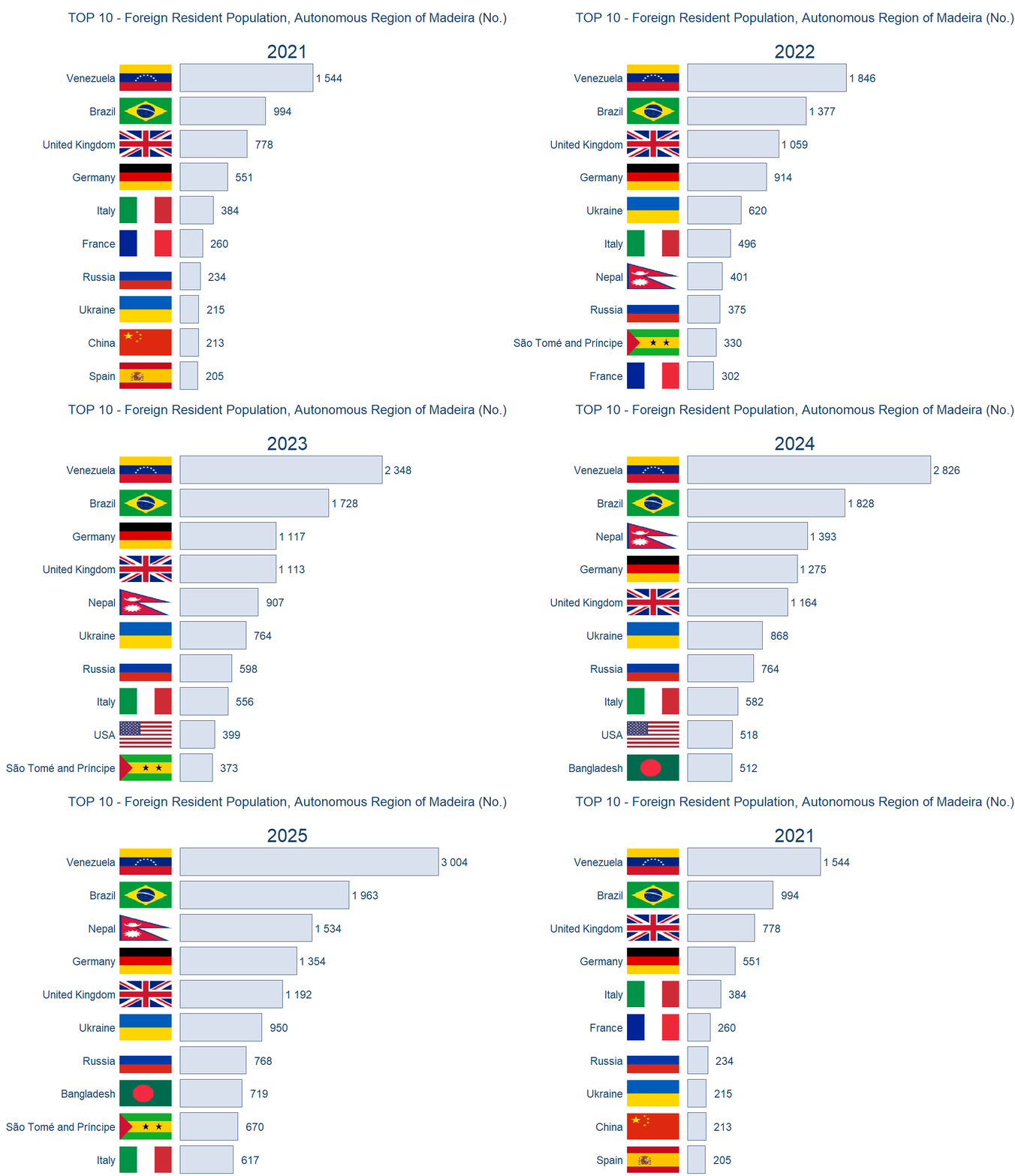
For more information, please click on:
International Statistical Cooperation
 |
International Statistical Cooperation
|
Statistical Literacy
 |
Statistical Literacy
|





Statistical authorities


Supervision and support


Copyright © 2026 Direção Regional de Estatística da Madeira. All rights reserved.
Privacy policy | Cookie Notice | Contact us | Sitemap | RAMStats 2.0 app
Address: Calçada de Santa Clara 38, 9004-545 Funchal, Madeira Island
Phone: +351 291 145 110 (National landline call)