











Newsletters
Subscribe to our newsletter and get statistical data as soon as it is available!...
:: Statistical Indicators ::
- Resident Population
- Natural Balance
- Unemployment
- GDP
- RIEAI
- Inflation
- Overnight Stays
- Dwelling Sales
- Companies
|
Resident Population Resident Population Estimates (31 December). |
|
2025, Resident Population Estimates based entirely on administrative data. 2021 - 2024, Revised Resident Population Estimates following the compilation of the 2025 Resident Population Estimates, based entirely on administrative data. Source: Statistics Portugal/DREM - Demographic Statistics |
|
Unemployment Rate Quarterly rate obtained from the Labour Force Survey, corresponding to the ratio of the unemployed population to the active population (%). |
|
Source: Statistics Portugal/DREM - Labour Force Survey |
|
Inflation Rate Average Rate of Change over the last 12 months of the Consumer Price Index (%). |
|
Source: Statistics Portugal/DREM - Consumer Price Index |
|
Overnight Stays Overnight stays recorded in total collective tourist accommodation (thousands). |
|
Source: Statistics Portugal/DREM - Tourism Statistics |
|
GDP Gross Domestic Product (GDP) of the Autonomous Region of Madeira at current prices, base 2021 (million euros). |
|
The value for 2024 is provisional. Source: Statistics Portugal - Regional Accounts (Base 2021) |
|
Family Dwelling Sales Number of Family Dwelling Sales (Total, New and Existing) in the Autonomous Region of Madeira. |
|
Source: Statistics Portugal (INE, IP.). |
|
Company Incorporation and Dissolution Number of companies incorporated and dissolved. |
|
Source: Directorate-General for Justice Policy |
|
Natural Balance Difference between the number of live births and the number of deaths in a given period of time (No.). |
|
* Preliminary data compiled up until June 5th 2026. Source: Statistics Portugal/DREM - Demographic Statistics |
|
Regional Indicator of Economic Activity 3-month moving average (%). |
|
Source: DREM |
:: Statistical Indicators ::
|
Population Resident Population estimates by the 31st of December. |
|
2025, Resident Population Estimates based entirely on administrative data. 2021 - 2024, Revised Resident Population Estimates following the compilation of the 2025 Resident Population Estimates, based entirely on administrative data. Source: INE/DREM - Demographic Statistics |
|
Unemployment Rate Quarterly rate derived from the Labour Fource Survey, which corresponds to the ratio between the unemployed and the active population(%). |
|
Source: INE/DREM - Labour Force Survey |
|
Inflation Rate 12-month average growth rate of the Consumer Price Index. |
|
Source: INE/DREM - Consumer Price Index |
|
Overnight stays Overnight stays in tourism accommodation (thousands). |
|
Source: INE/DREM - Tourism Statistics |
|
GDP Gross Domestic Product (GDP) of the Autonomous Region of Madeira at current prices, base 2021 (millions of euros). |
|
The value for 2024 is provisional. Source: INE - Regional Accounts (Base 2021) |
|
Dwelling Sales Number of Dwelling Sales (Total, New e Existing), in the Autonomous Region of Madeira. |
|
Source: Statistics Portugal |
|
Formation and Dissolution of Companies Number of formed and dissolved companies. |
|
Source: Directorate-General for Justice Policy |
|
Natural Change Balance between the number of live births and the number of deaths in a given time period (No.). |
|
* Preliminary data compiled up until May 8th, 2026. Source: INE/DREM - Demographic Statistics |
|
Regional Indicator of Economic Activity 3-month moving average (%). |
|
Source: DREM |
:: Publications ::
-

Annual publication
Price: papel - 3,50 € / PDF - Free
Year of publication: 2024
Reference period: 2023
Quarterly Bulletin of Statistics
Quarterly publication
Price: paper - 4,00 € / PDF - Free
Year of publication: 2025
Reference period: 2nd Quarter 2025
-
Annual publication
Price: paper - 22,00 € / PDF - Free
Year of publication: 2024
Reference period: 2023

Census - Final results: Autonomous Region of Madeira - 2021
Annual publication
Price: paper - 10,00 € / PDF - Free
Year of publication: 2023
Reference period: 2021
-

Annual publication
Price: PDF - Free
Year of publication: 2026
Reference period: 2025

Monthly publication
Price: paper - 3,00 € / PDF - Free
Year of publication: 2025
Reference period: December 2024
-

Annual publication
Price: paper - 10,00 € / PDF - Free
Year of publication: 2024
Reference period: 2023

Annual publication
Price: paper- 12,00 € / PDF - Free
Year of publication: 2026
Reference period: 2024
-

International Trade Statistics
Annual publication
Price: paper- 6,00 € / PDF - Free
Year of publication: 2021
Reference period: 2020

Quarterly publication
Price: paper- 2,00 € / PDF - Free
Year of publication: 2025
Reference period: 4th Quarter 2024
-

Annual publication
Price: paper - 4,00 € / PDF - Free
Year of publication: 2024
Reference period: 2023

Agriculture and Fishery Statistics
Annual publication
Price: paper - 3,50 € / PDF - Free
Year of publication: 2024
Reference period: 2023
-

Annual publication
Price: paper - 12,00 € / PDF - Free
Year of publication: 2021
Reference period: 2019

Construction and Housing Statistics
Annual publication
Price: paper - 4,50 € / PDF - Free
Year of publication: 2024
Reference period: 2023
:: Publicações ::
-
Annual publication
Price: paper - 3,50 € / PDF - Free
Year of publication: 2024
Reference period: 2023
-

Annual publication
Price: paper - 22,00 € / PDF - Free
Year of publication: 2023
Reference period: 2022
-

Monthly publication
Price: paper - 1,50 € / PDF - Free
Year of publication: 2025
Reference period: May 2025
-
Annual publication
Price: paper - 10,00 € / PDF - Free
Year of publication: 2024
Reference period: 2023
-
International Trade Statistics
Annual publication
Price: paper - 6,00 € / PDF - Free
Year of publication: 2021
Reference period: 2020
-
Annual publication
Price: paper - 4,00 € / PDF - Free
Year of publication: 2024
Reference period: 2023
-
Annual publication
Price: paper - 12,00 € / PDF - Free
Year of publication: 2021
Reference period: 2019
-
Quarterly Bulletin of Statistics
Quarterly publication
Price: paper - 4,00 € / PDF - Free
Year of publication: 2025
Reference period: 2nd Quarter 2025
-
Census - Final results. Autonomous Region of Madeira - 2021
Annual publication
Price: paper - 10,00 € / PDF - Free
Year of publication: 2023
Reference period: 2021
-
Construction and Housing Statistics
Annual publication
Price: paper - 4,50 € / PDF - Free
Year of publication: 2023
Reference period: 2022
-
Agriculture and Fishery Statistics
Annual publication
Price: paper - 3,50 € / PDF - Free
Year of publication: 2024
Reference period: 2023
-
Quarterly publication
Price: paper - 2,00 € / PDF - Free
Year of publication: 2026
Reference period: 1st Quarter 2026
-
Annual publication
Price: paper - 12,00 € / PDF - Free
Year of publication: 2024
Reference period: 2022
-
Monthly publication
Price: paper - 3,00 € / PDF - Free
Year of publication: 2025
Reference period: December 2024
DREM releases final data for the 2023 Regional Accounts and provisional data for 2024
Statistics Portugal (INE) released today the results of the Regional Accounts for the years 2023 and 2024, final and provisional in nature, respectively.
The Regional Accounts for 2023 and 2024 are consistent with the provisional National Accounts released by INE in September last year and follow the methodological framework of the European System of Accounts (ESA 2010). The current accounting base is base 2021.
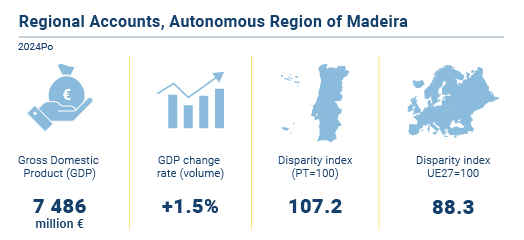
Regional Gross Domestic Product reached 7.5 billion euros in 2024, growing by 1.5% in real terms
According to provisional information for 2024, the Gross Domestic Product (GDP) of the Autonomous Region of Madeira amounted to 7.5 billion euros, reflecting growth of 7.5% in nominal terms and 1.5% in real terms.
This implies that the Region recorded nominal growth above the national average, while real growth stood below that same average.
In fact, Portugal’s GDP registered nominal growth of 7.1%, with positive changes observed across all regions of the country. Algarve (+8.3%), Península de Setúbal (+7.8%) and the Autonomous Region of Madeira (+7.5%) stood out by exceeding the national average. Norte (+7.2%), Grande Lisboa and the Autonomous Region of the Azores (both +7.1%) recorded growth rates close to the national average, while Centro (+6.7%), Oeste e Vale do Tejo (+6.6%) and, in particular, Alentejo (+4.5%) posted nominal growth below the national average.
In real terms (the metric commonly used to measure economic growth, as it excludes price effects), Portuguese GDP increased by 2.1%, with slightly differentiated growth across regions. Alentejo (+1.1%) and the Autonomous Region of Madeira (+1.5%) are estimated to have recorded the lowest growth rates. In the remaining regions, growth was close to the national average: Centro (+2.1%) matched the national performance, while Oeste e Vale do Tejo, Grande Lisboa and Península de Setúbal slightly exceeded it, with real growth of 2.2%. Norte, Algarve and the Autonomous Region of the Azores recorded growth of 2.3%, i.e. 0.2 percentage points above the national average.
The real increase in Madeira’s GDP was constrained by a reduction in Gross Value Added (GVA) in business services (-4.4%), associated with lower activity in the Madeira International Business Centre (MIBC), as well as by a decline in GVA in public administration, defence, health and education (-0.3%). It should be noted that, excluding the negative contribution of the MIBC, regional real GDP growth would have been very close to the national average.
In 2024, three NUTS 2 regions were above the national average: Grande Lisboa (index 156.5), Algarve (108.3) and the Autonomous Region of Madeira (107.2). The regions with the lowest GDP per capita were Península de Setúbal (67.3) and Oeste e Vale do Tejo (78.4). The Autonomous Region of the Azores recorded an index of 88.1, above Norte (86.0) and Centro (85.9), but below Alentejo (93.7).
When compared with the average of the 27 European Union Member States, Grande Lisboa was the only Portuguese region with an index above 100 (128.9). In 2024, Madeira recorded an index of 88.3, ranking below Algarve, which achieved the second-best performance with an index of 89.2. The Península de Setúbal recorded the lowest index (55.4), followed by Oeste e Vale do Tejo (64.6). The Autonomous Region of the Azores registered a value of 72.5.
Regarding apparent labour productivity (the ratio between GVA and the corresponding level of employment), Madeira recorded a value of 50.5 thousand euros in 2024, the second highest in the country, surpassed only by Grande Lisboa (58.3 thousand euros). These were the only two regions above the national average (47.7 thousand euros).
In 2023, Gross Disposable Income (GDI) per capita in Madeira exceeded the national average, contrary to the previous two years
Final data for 2023 show that regional GDP approached 7.0 billion euros, recording growth of 11.1% in nominal terms compared with the previous year and 4.6% in real terms, exceeding the national figures (10.8% and 3.1%, respectively). Compared with provisional data, revisions for Madeira amounted to -0.4 percentage points in nominal GDP growth and +0.1 percentage points in real GDP growth.
In 2023, total investment in Madeira amounted to 1 111.4 million euros, representing a growth of 6.3% compared with the previous year, below the national increase (+10.3%).
Alentejo (+15.5%), Península de Setúbal (+14.2%), Oeste e Vale do Tejo (+13.0%) and Grande Lisboa (+12.2%) stood out by recording growth in Gross Fixed Capital Formation (GFCF) above the national average, while Algarve (+6.7%) and Madeira (+6.3%) recorded the lowest growth rates.
In 2023, both Gross Primary Product (GPI) and Gross Disposable Income (GDI) in Madeira recorded positive developments. In nominal terms, year-on-year growth was of a similar magnitude for both indicators, at +12.2% and +11.6%, respectively. At the national level, growth rates differed more markedly: 11.1% for GPI and 9.1% for GDI. The regions with the highest growth in GPI were Alentejo (+12.9%), Algarve (+12.8%) and Madeira (+12.2%), while the Autonomous Region of the Azores recorded the smallest increase compared with 2022 (+9.9%). Regarding GDI, the Azores led growth (+11.6%), followed by Alentejo (+11.1%) and Algarve (+10.2%), while the Northern Region recorded the lowest increase (+8.5%).
Analysis of the evolution of the disparity index of GPI compared to the national average between 2022 and 2023 shows a positive development in Madeira, with the index moving closer to the national average (98.7). Meanwhile, the disparity index of GDI exceeded the national average by 1.7 percentage points, reaching 101.7 in 2023, compared with 99.2 in 2022.
Grande Lisboa and Algarve were the only two regions to record levels simultaneously above the national average for GPI, GDI and GDP per capita in 2023. For the Autonomous Region of Madeira to join this group, it would have been necessary to exceed the national average in terms of the GPI per capita disparity index (98.7), as this threshold was already surpassed for GDI (101.7) and GDP per capita (107.2).
For more information, please click on:
International Statistical Cooperation
 |
International Statistical Cooperation
|
Statistical Literacy
 |
Statistical Literacy
|





|
|
|
|
 |
 |
|


 |
|
|
 |

Copyright © 2026 Direção Regional de Estatística da Madeira. All rights reserved.
Address: Calçada de Santa Clara 38, 9004-545 Funchal, Madeira Island
Phone: +351 291 145 126 (National landline call)