










Newsletters
Subscribe to our newsletter and get statistical data as soon as it is available!...
DREM releases data from the 2023 Survey on Income and Living Conditions
The Regional Directorate of Statistics of Madeira (DREM) conducts an annual Survey on Income and Living Conditions (SILC) in the Autonomous Region of Madeira (ARM). This statistical operation falls within the national scope and is under the responsibility of Statistics Portugal (INE). The survey, harmonized and regulated at the community level, aims to produce statistics on income distribution, living conditions, and social exclusion.
The objectives of the survey can be summarized as follows:
- Analysis of the composition and distribution of households and persons.
- Examination of living conditions (housing and comfort conditions, financial capacity, etc.).
- Evaluation of the impact of social transfers on poverty and social exclusion.
- Investigation of the connection between poverty and social exclusion and economic activity, employment, socio-family typology, education, health, and housing.
In this context, DREM has released today the results of the survey conducted between April and July 2023, covering a sample of 2,993 households. Indicators related to poverty and economic inequality were constructed based on the annual net equivalised monetary income of 2022, excluding other sources of income such as in-kind wages, self-consumption, self-supply, and self-housing.
Evolution of the at-risk of poverty rate in A. R. Madeira with national poverty line at odds with the Country's trend
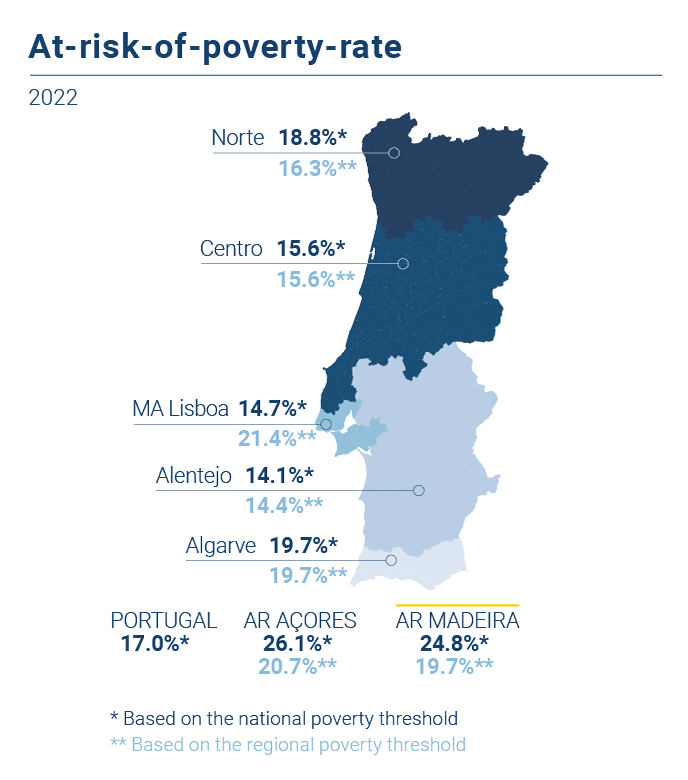
The at-risk-of-poverty rate, calculated as the proportion of the population whose equivalent income falls below the poverty line (7,095 euros annually, representing 60% of the median equivalised disposable income per equivalent adult for Portugal), was 17.0% in the country in 2022 (an increase of 0.6 percentage points compared to 2021). In the ARM, this rate reached 24.8% (a decrease of 1.1 pp compared to 2021). By NUTS 2 regions, the lowest value was recorded in Alentejo (14.1%), and the highest was in the Autonomous Region of the Azores (26.1%). The region in the country with the greatest reduction in the poverty risk rate was the Algarve (-2.4 pp), followed by the Norte (-1.2 pp) and the ARM (-1.1 pp). Conversely, the highest increase was in Área Metropolitana de Lisboa (+4.3 pp), followed by the Autonomous Region of the Azores (+1.0 pp). Notably, 2022 experienced a growth in price levels, with inflation in the region reaching 7.0% (7.8% in the country), adversely affecting families' purchasing power. However, the at-risk-of-poverty rate with the national poverty line decreased in four of the seven regions of the country (Norte, Alentejo, Algarve, and the ARM). In terms of the available short time series, this is the second-lowest value in the ARM since the beginning of the time series for this variable (2017), after 2020 (24.2%).
The at-risk poverty rate can also be calculated based on regional poverty lines, which have the advantage of reflecting different socio-economic conditions, including different levels of the cost of living. In each NUTS 2 region, the regional poverty line corresponds to the proportion of inhabitants in that region living with who live on equivalent net monetary incomes of less than 60% of the median of the distribution of equivalent net monetary incomes in that same region.
The at-risk poverty rate calculated based on the regional poverty lines in the ARM, corresponding to 60% of the median annual net monetary income per equivalent adult in the Region, was 19.7%. In this indicator, Alentejo recorded the lowest value (14.4%), while Área Metropolitana de Lisboa (21.4%) and the Autonomous Region of the Azores (20.7%) had the highest percentage, followed by Algarve and the ARM, with the same percentage (19.7%).
When interpreting these data, it should be noted that, due to the survey methodology regarding income sources, in-kind wages, self-consumption, self-supply, and self-rental (non-monetary income) are excluded. These components, as demonstrated by the last Household Budget Survey (HBS), are particularly significant in the ARM, contributing to a 6.2 pp reduction in the poverty rate in 2014 (the last known IDEF results). Note that the results of this survey conducted in 2022 should be known later this year.
Severe material and social deprivation rate in the Autonomous Region of Madeira decreases for the third consecutive year
As part of the Europe 2030 strategy, the concept of material and social deprivation was defined for monitoring poverty and social exclusion. Indicators of material and social deprivation are based on a set of thirteen items related to the social and economic needs and durable goods of households.
In contrast to previous indicators of material deprivation, which focused on household and economic-financial difficulties, the new indicators of material and social deprivation add aspects related to the well-being of each person (new clothing, footwear, and pocket money), as well as leisure and social interaction. Of the thirteen items of material and social deprivation, seven pertain to the family as a whole, and six at the personal level.
The material and social deprivation rate is expressed as the proportion of the population in which at least five of the following thirteen difficulties occur:
Difficulties at the household level:
1) Lack of capacity to immediately cover an unexpected expense close to the monthly value of poverty line (without asking for financial help).
2) Lack of capacity to pay for a week of vacation per year, away from home, covering accommodation and travel expenses for all members of the household.
3) Delay, due to economic difficulties, in any regular payments related to rents, credit installments, or current expenses of the main residence, or other expenses not related to the main residence.
4) Lack of financial capacity to have a meal of meat or fish (or a vegetarian equivalent) at least every 2 days.
5) Lack of financial capacity to keep the house adequately heated.
6) Unavailability of a car (passenger or mixed) due to economic difficulties.
7) Inability to replace used furniture.
- Difficulties at the personal level (16 years or older):
8) Inability to replace used clothing with some new clothing (excluding second-hand clothing).
9) Inability to have two pairs of shoes of suitable size (including one pair of shoes for all weather conditions).
10) Inability to spend a small amount of money on oneself weekly.
11) Inability to participate regularly in a leisure activity.
12) Inability to meet friends/family for a drink/meal at least once a month.
13) Inability to have access to the internet for personal use at home.
For items of material and social deprivation, and for overall deprivation indicators, the household situation is replicated for all its members, regardless of age. For items of deprivation collected at the personal level, children under 16 are considered deprived if at least half of the persons aged 16 or older in the household report being deprived.
In the ARM, in 2023, the severe material and social deprivation rate was 6.3%, marking a decrease of 1.5 percentage points compared to 2022. In the country, this rate was 4.9%, having decreased by 0.4 percentage points. It is noteworthy that the ARM value is the lowest in the short available series (since 2015). Alentejo (3.0%) is the region with the lowest value in this indicator, contrasting with the Autonomous Region of the Azores (12.0%) on the opposite end. Compared to the previous year, the ARM (-1.5 pp) and Algarve (-1.4 pp) show the largest decreases, while the Autonomous Region of the Azores has the largest increase (+2.2 pp).
Very low per capita labour intensity in the Autonomous Region of Madeira reduced to 7.4%
Persons under the age of 65 who, during the income reference period, lived in households where the adult population aged 18 to 64 reported working, on average, less than 20% of the possible working time, excluding students aged 18 to 24; retirees and/or pensioners due to old age or disability; and inactive persons aged 60-64 living in households whose main source of income is pensions, are considered to have very low per capita labour intensity.
In 2022, in the ARM, the proportion of the population under 65 living in households with very low per capita labour intensity was 7.4%, reflecting a decrease of 1.4 percentage points compared to the previous year. This also stands as the lowest value in the short available series. The national average was 6.3% (+0.7 percentage points). By regions, the lowest value was recorded in Alentejo (4.1%), and the highest values were in the Autonomous Region of the Azores (8.9%) and Área Metropolitana de Lisboa (8.3%). Compared to 2021, the greatest reductions in per capita labour intensity were recorded in Algarve (-2.3 pp) and the ARM (-1.4 pp), with the highest increase in Área Metropolitana de Lisboa (+2.9 pp).
Poverty or social exclusion risk rate in the Autonomous Region of Madeira reduced to 28.1% in 2023
The Europe 2030 strategy defines, among other objectives, the reduction of the number of persons at risk of poverty or social exclusion in the European Union by at least 15 million persons by 2030, including at least 5 million children.
The same strategy defines a new indicator for monitoring the population at risk of poverty or social exclusion, which combines conditions of relative poverty, severe material and social deprivation, and very low per capita labour intensity. In accordance with the European convention, the indicator takes as reference the year to which the situation of severe material and social deprivation applies, despite the risk of relative at-risk poverty being the determining element in its trajectory.
In 2023, in the Autonomous Region of Madeira, the risk of poverty or social exclusion rate (incomes from 2022) was 28.1%, reflecting a decrease of 2.1 percentage points compared to 2022, reaching the lowest value since the sample of SILC has representativity at the regional level. The Autonomous Region of the Azores recorded the highest rate (31.4%), while Alentejo had the lowest rate (16.4%). The national average remained unchanged at 20.1%. Compared to 2022, the greatest reductions occurred in Algarve (-3.1 pp) and the ARM (-2.1 pp), with the largest increases in Área Metropolitana de Lisboa (+3.8 pp) and the Autonomous Region of the Azores (+1.1 pp).
Inequality Indicators with divergent evolution
The Gini coefficient and the S80/S20 ratio allow the assessment of asymmetry in the distribution of incomes in the ARM and in the country, reflecting income differences among all population groups.
The Gini coefficient synthesizes in a single value the asymmetry of the income distribution, taking values between 0 (when all persons have equal income) and 100 (when all income is concentrated in a single individual). In 2022, regarding the ARM, this indicator assumed a value of 32.7%, slightly increasing compared to the previous year (+0.3 pp). At the national level, the Gini coefficient recorded a greater worsening, increasing from 32.0% in 2021 to 33.7%, returning to the situation observed in 2019 and 2020, where the ARM is below the national value, meaning lower income inequality. Among the 7 NUTS 2 regions, only Alentejo (30.0%) and Norte (32.5%) present a Gini coefficient lower than the ARM. The Autonomous Region of the Azores has the highest asymmetry (36.0%). Compared to 2021, only Alentejo (-0.8 p.p.) experienced a decline in this indicator. In regions where this indicator grew, the ARM had a less pronounced increase (+0.3 pp), and Área Metropolitana de Lisboa had the most significant increase (+3.5 pp).
The S80/S20 ratio, defined as the ratio between the proportion of total income received by the top 20% of the population with the highest incomes and the part of the income earned by the bottom 20% of the lowest incomes, reached a value of 5.2 in 2022 (5.3 in 2021). In the country, this indicator grew from 5.1 in 2021 to 5.6 in 2022. By region, Alentejo has the lowest ratio (4.5), and Área Metropolitana de Lisboa has the highest (6.2). After Alentejo, the lowest values of the S80/S20 ratio are recorded by three regions ex-aequo (Norte, Centro, and the ARM with 5.2). Compared to 2021, only two regions improved in this indicator, Alentejo (-0.3), and the ARM (-0.1). The most significant worsening occurred in Área Metropolitana de Lisboa (+1.1).
For more information, please click on:
International Statistical Cooperation
 |
International Statistical Cooperation
|
Statistical Literacy
 |
Statistical Literacy
|
|
|
|
|
 |
 |
|


 |
|
|
 |

Copyright © 2026 Direção Regional de Estatística da Madeira. All rights reserved.
Address: Calçada de Santa Clara 38, 9004-545 Funchal, Madeira Island
Phone: +351 291 145 126 (National landline call)