











Newsletters
Subscribe to our newsletter and get statistical data as soon as it is available!...
In January 2025
Regional economy maintained its growth trajectory
The Regional Indicator of Economic Activity (RIEA) reveals that in January 2025, the regional economic activity although experiencing a deceleration, continued to expand.
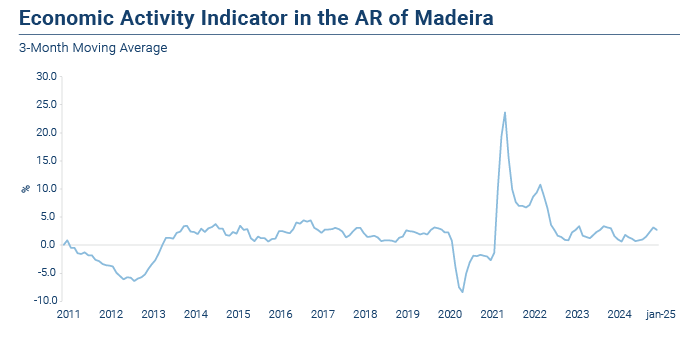
As previously stated by the Regional Directorate of Statistics of Madeira (DREM) in the initial release of the RIEA in October 2017, the objective of this indicator is “to signal the behaviour of economic activity, particularly with regard to its direction and the magnitude of its fluctuations: whether the economy is in positive or negative territory, and to identify accelerations, decelerations, and turning points.” Its quantitative value is therefore of secondary importance, and it should not be interpreted as a substitute for the actual change in Gross Domestic Product (GDP), which is to be determined using a broader and more comprehensive set of statistical information, although a strong correlation exists between the two variables.
Economic Overview – Analysis of the economic context of the Autonomous Region of Madeira in January 2025
The Regional Directorate of Statistics of Madeira (DREM) presents an analysis of the main short-term economic indicators, grouped by theme. It is important to note that many of the changes presented correspond to three-month moving averages — a methodology often employed in publications of this nature to smooth out short-term fluctuations and highlight underlying trends.
Economic Activity
In January 2025, the regional economy maintained its growth trajectory, primarily driven by tourism, with overnight stays in tourist accommodations increasing by 8.5%, above the 6.0% recorded in December. Total revenue also exhibited substantial growth, rising by 26.0%, exceeding the previous month's figure of 21.2%.
Electricity distribution, often associated with the evolution of economic activity, increased by 3.5%, accelerating from 2.2% in December.
As for diesel released for consumption, there was a growth of 2.6%, below the 3.8% observed in December 2024.
The ratio of company incorporations to dissolutions remained positive, with 2.7 new companies for every dissolution, the same as the previous month.
Qualitative Indicators
In January 2025, confidence indicators in the Manufacturing Industry and Trade sectors increased compared to the previous month, while those in Construction and Public Works and Services declined.
Private Consumption
The volume of transactions on the SIBS network using domestic bank cards grew by 8.8% in value, showing a slight deceleration compared to 9.1% in December.
Gasoline released for consumption increased by 9.5%, a figure close to that of the previous month (9.3%).
The purchase of new passenger cars continued to decline, falling by 12.4%, though the contraction was less pronounced than that observed in December 2024 (-17.4%).
Consumer loan balances grew by 6.3%, slightly below the 6.4% increase noted in the prior month.
Investment
Investment indicators showed mixed results. Housing bank appraisal values stood out positively, with a 15.8% increase, and building permits rose by 6.2%.
Sales of new light commercial vehicles increased by 34.7%, despite being a slowdown compared to December’s 51.5%.
Cement sales grew by 3.3%, well below the 18.5% recorded in the previous month.
Conversely, loans granted to non-financial corporations continued their downward trajectory, falling by 6.7%.
External Demand
Although foreign trade represents only a small share of the region’s overall trade activity (most exchanges occur with mainland Portugal), it is worth noting that exports experienced a recovery, growing by 5.0%, in contrast with a 2.4% decline in December. Imports, however, reversed their growth trend and fell by 5.2% (compared to +7.3% in the previous month).
The movement of goods handled in ports declined by 1.1%, contrasting with the 3.5% growth observed in December.
On the other hand, passenger traffic at airports increased by 8.7% in January 2025, accelerating from 6.8% in the previous month.
Withdrawals and purchases using international bank cards at automatic payment terminals (APTs) grew by 14.7%, slightly below the 15.6% recorded in December.
Labour Market
In the labour market, job offers rose by 9.3%, below the 21.5% increase in the previous month. The number of registered unemployed persons fell by 5.0%, intensifying the downward trend seen in previous months. Job applications also fell by 3.6%, following a 0.4% decline in December.
Prices
The year-on-year inflation rate rose to 4.3% in January 2025, compared to 4.0% in the previous month. Inflation was lower for goods (2.8%) and higher for services (6.3%).
The underlying inflation indicator increased to 4.5%, exceeding the 4.2% recorded in December.
DREM releases the Economic Overview dashboard
Alongside this first 2025 release of the Economic Overview, DREM will shortly make available a data dashboard featuring the indicators included in the publication.
Users may select from the seven thematic areas of the Economic Overview (economic activity, qualitative indicators, private consumption, investment, external demand, labour market, and prices) and visualise the evolution of each indicator. The temporal scope of the data can also be expanded or restricted as required.
For more information, visit:
International Statistical Cooperation
 |
International Statistical Cooperation
|
Statistical Literacy
 |
Statistical Literacy
|
|
|
|
|
 |
 |
|


 |
|
|
 |

Copyright © 2026 Direção Regional de Estatística da Madeira. All rights reserved.
Address: Calçada de Santa Clara 38, 9004-545 Funchal, Madeira Island
Phone: +351 291 145 126 (National landline call)