











Newsletters
Subscribe to our newsletter and get statistical data as soon as it is available!...
DREM releases an expanded time series of the lists of personnel for 2022
The Regional Directorate of Statistics of Madeira (DREM) has made available the Time Series of the Lists of Personnel, now including 2022 data concerning full-time employees (FTEs) receiving full earning in the Autonomous Region of Madeira (ARM).
This expanded series incorporates additional data categories, such as the age group of FTEs, nationality, contract type (permanent or fixed-term), primary occupation, enterprise transitions, and net attraction rate. Moreover, for certain variables, data on disparities and quartiles of average monthly earnings are also provided.
The data are supplied to Statistics Portugal (INE) by the Strategy and Planning Office of the Ministry of Labour, Solidarity, and Social Security. The statistical compilation of the Personnel Charts is based on Annex A of the Single Report - an annual document detailing the social activities of enterprises, completed by employers with at least one employee. In the ARM, this statistical operation is conducted with the collaboration of the Regional Directorate for Labour and Inspection (DRTAI).
The geographic breakdown of the data corresponds to the workplace location of the employees, with the information being allocated based on the establishment's address.
Key Indicators:
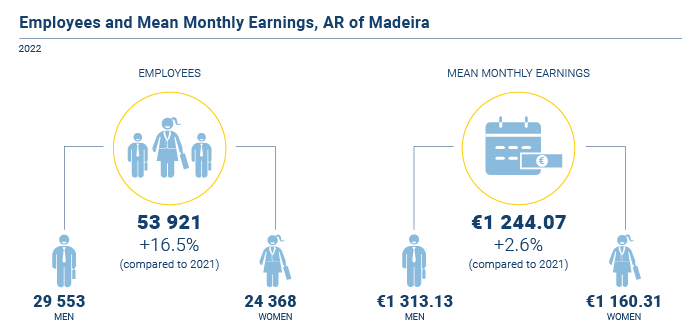
- In 2022, 53,900 FTEs receiving full earning were recorded in establishments located in the ARM, representing a 16.5% increase compared to the previous year. This figure marks a historical peak, surpassing the previous record of 53,700 in 2008.
- The average monthly earnings of FTEs in 2022 were 1,244.07 euros, an increase of 2.6% compared to the previous year (1,212.39 euros). Nationally, average earnings stood at 1,362.37 euros, with the ARM trailing Grande Lisboa (1,705.10 euros), Peninsula de Setúbal (1,361.00 euros), and Norte (1,253.50 euros), but exceeding Algarve (1,150.80 euros), Oeste and Vale do Tejo (1,165.70 euros), Azores (1,191.10 euros), Centro (1,218.10 euros), and Alentejo (1,225.00 euros).
- Earnings distribution in the ARM showed lower asymmetry than the national average. The median monthly earnings in the ARM were 962.06 euros, with a third-to-first quartile ratio of 1.56. Nationally, the median was 1,013.94 euros, and the ratio was 1.77.
- The earnings distribution was more asymmetric among male FTEs. The median monthly earnings gap between genders was evident, with 921.62 euros for females and 1,000.00 euros for males. Gender disparity in average monthly earnings continued to decline, standing at 6.1% in 2022 (compared to 8.6% nationally).
- The highest median earnings were among FTEs aged 35–54 (995.13 euros), while those under 34 earned the lowest median (908.54 euros).
- The median monthly earnings of full-time employees (FTEs) working in the region in 2022 with non-European Union (non-EU-27) nationalities were 43.75 euros lower than those of FTEs with Portuguese nationality, amounting to 920.00 euros and 963.75 euros, respectively.
- Median monthly earnings increased with educational attainment, ranging from 890.92 euros for FTEs with no formal education to 1,520.06 euros for those with higher education qualifications. The disparity in average monthly earnings between educational attainment levels stood at 27.1% in the Autonomous Region of Madeira, compared to 31.2% at the national level.
- Median monthly earnings for permanent contract holders (1,019.00 euros) exceeded those of fixed-term contract holders (885.59 euros).
- The secondary sector offered the highest average monthly earnings (1,274.46 euros), 2.4% above the regional average. The disparity in average monthly earnings across economic sectors was 2.3% in the Autonomous Region of Madeira, compared to 5.3% nationally.
- Larger companies (500+ employees) reported the highest average monthly earnings (1,541.49 euros), 23.9% above the regional average, while smaller companies (1–9 employees) recorded the lowest (992.74 euros), despite a 5.0% increase from 2021. The disparity in average monthly earnings across company workforce size categories was 16.2% in the Autonomous Region of Madeira, compared to 16.9% nationally.
- “Personal service, security and safety workers and salespeople” saw the largest increase in average monthly earnings (6.3%), followed by “Farmers and skilled workers in agriculture, fisheries and forest” (6.2%). The average monthly earnings for these groups were 977.53 euros and 926.65 euros, respectively. Over the past decade, the disparity in average monthly earnings between professions has decreased, from 41.8% in 2012 to 32.8% in 2022, compared to 36.9% at the national level in 2022.
- In 2022, 9.9% of the employed population changed companies, a 1.9 percentage point increase from 2021. The net attraction rate was negative in all municipalities except Funchal and Ribeira Brava, which recorded rates of 1.3% and 2.9%, respectively. Porto Santo had the lowest rate (-7.4%), with the regional average at 1.2%, a slight 0.1 percentage point increase from 2021.
For more information, please click on:
International Statistical Cooperation
 |
International Statistical Cooperation
|
Statistical Literacy
 |
Statistical Literacy
|
|
|
|
|
 |
 |
|



 |
|
|
 |

Copyright © 2026 Direção Regional de Estatística da Madeira. All rights reserved.
Privacy policy | Cookie Notice
Address: Calçada de Santa Clara 38, 9004-545 Funchal, Madeira Island
Phone: +351 291 145 110 (National landline call)