











Newsletters
Subscribe to our newsletter and get statistical data as soon as it is available!...
In 2023
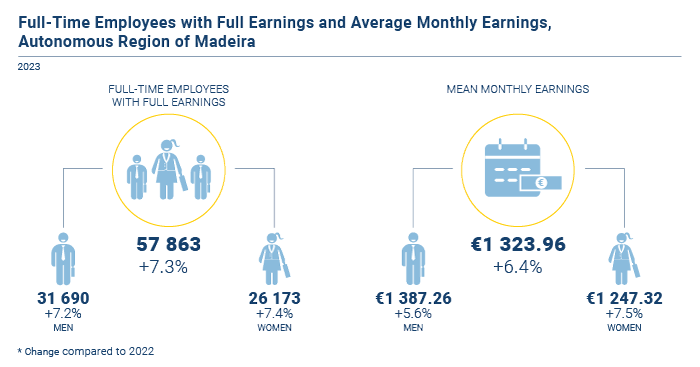
Average monthly earnings of full-time employees with full earnings increased 6.4%, settling at 1 323.96 euros
The Regional Directorate of Statistics of Madeira (DREM) today publishes on its website the updated Time Series of the Lists of Personnel, now including 2023 data that is provided to Statistics Portugal by the Strategy and Planning Office of the Ministry of Labour, Solidarity, and Social Security. The statistical compilation of the Personnel Charts is based on Annexe A of the Single Report - an annual document detailing the social activities of enterprises, completed by employers with at least one employee. In the Autonomous Region of Madeira (ARM), this statistical operation is conducted in collaboration with the Regional Directorate for Labour and Inspection (DRTAI). The geographic breakdown of the data corresponds to the workplace location of the employees, with the information being allocated based on the establishment's address.
In 2023, as part of the statistical operation conducted, 57.9 thousand employees under full-time employment contracts with full remuneration (FTEs) were recorded in establishments located in the ARM, representing a 7.3% increase compared to the previous year (+3.9 thousand employees). The ARM followed, more sharply, the national trend of growth in the number of employees, whose change was 4.0%.
The average monthly earnings of FTEs in 2023 were 1 323.96 euros, a higher value than the previous year, which was set at 1 244.07 euros, which corresponds to an increase of 6.4%. Nationally, average earnings stood at 1 460.81 euros, representing an increase of 7.2% compared to 2022. By NUTS 2 regions, the ARM occupied a central position in the ranking, presenting the fifth highest value, behind the regions of Grande Lisboa (1 817.17 euros), Península de Setúbal (1 433.11 euros), Norte (1 348.66 euros) and Alentejo (1 326.13 euros). The Algarve region presented the lowest average monthly earning (1 238.68 euros), followed by Oeste e Vale do Tejo (1 249.77 euros), Centro (1 305.72 euros) and the Autonomous Region of the Azores (1 315.09 euros).
In the Region, the municipality of Funchal had the highest average monthly earnings (1 377.85 euros), followed by Porto Santo (1 345.14 euros), the only ones that were above the regional average (1 323.96 euros). Instead, Porto Moniz (1 000.11 euros), São Vicente (1 043.69 euros), Santana (1 060.20 euros), Ponta do Sol (1 094.29 euros), Ribeira Brava (1 129.80 euros), Câmara de Lobos (1 137.18 euros), Machico (1 229.68 euros), Santa Cruz (1 275.64 euros) and Calheta (1 321.53 euros) were below the regional average.
In 2023, the earnings distribution in the ARM showed lower asymmetry than the national average. The median monthly earnings in the ARM were 1 039,76 euros, with a third-to-first quartile ratio of 1.51. Nationally, the median was 1 097,66 euros, and the ratio was 1.74.
By NUTS 2 regions, Grande Lisboa presented the highest median monthly earnings, reaching 1 323.92 euros, followed by Centro with 1 071.47 euros, Peninsula de Setúbal with 1 068.94 euros, Norte with 1 049.20 euros, Alentejo with 1 043.76 euros and the ARM with 1 039.76 euros. The Autonomous Region of the Azores (ARA), Algarve and Oeste e Vale do Tejo were the regions that presented the lowest median values, reaching 1 018.70 euros, 1 029.57 euros and 1 036.75 euros, respectively.
The Grande Lisboa region stands out as the region with the greatest asymmetry, having presented a value of 2.17 for the third-to-first quartile ratio, while the Autonomous Region of Azores and Algarve were the regions that presented the lowest ratios, both with 1.48.
In the Region, the difference in median monthly earnings between the two sexes was also notable: 1 007.87 euros for women and 1 069.79 euros for men. The disparity in mean monthly earnings between sexes has been decreasing in the ARM, reaching 5.3% in 2023, below the 8.3% nationwide.
In 2023, average earnings were highest among FTEs aged 35–54, standing at 1 077.59 euros. FTEs up to 34 years of age had the lowest median value, at 983.17 euros, and those aged 55 and over had a median value of 1 048.46 euros.
The median monthly earnings of full-time employees (FTEs) working in the region in 2023 with non-European Union (non-EU-27) nationalities were 106.65 euros lower than those of FTEs with Portuguese nationality, amounting to 939.77 euros and 1 046.42 euros, respectively.
Median monthly earnings followed the increase in educational attainment, rising from 946.49 euros for employees with no education to 1 616.97 euros for employees with higher education. In 2023, the disparity in average monthly earnings between educational attainment levels in the ARM stood at 26.6%, lower than the 30.8% for the country as a whole.
In the ARM, in 2023, median monthly earnings for permanent contract holders (1 103.24 euros) exceeded those of fixed-term contract holders (950.00 euros).
In 2023, the "Industry, construction, energy and water" sector had the highest average monthly earning (1 336.76 euros), 1.0% above the regional average. "Services" (1 323.32 euros) and "Agriculture, livestock production, hunting, forestry and fishing" (1 042.46 euros) sectors had values below this average. The disparity in average monthly earnings between sectors of activity in the Autonomous Region of Madeira was 1.9%, below the 5.2% nationally.
Enterprises with 500 or more employees recorded the highest average monthly earnings, 1 614.45 euros, standing 21.9% above the regional average, and enterprises with 1 to 9 employees recorded the lowest average monthly earnings (1 081.19 euros), although they recorded an 8.9% increase compared to 2022. The disparity in average monthly earnings between employee classes in enterprises in the ARM stood at 15.0%, lower than the national figure of 16.4%.
Regarding average earnings by main occupation, the largest increase was seen in "Plant and machine operators and assembly workers", a group that registered an increase of 8.5% (+96.11 euros) compared to 2022, followed by " Personal service, security and safety workers and salespeople", with a growth of 7.9% (+77.44 euros), in 2023, the average earnings of these main occupations standing at 1 229.06 euros and 1 054.97 euros, respectively. The disparity in average monthly earnings between main occupations in the ARM has been decreasing in recent years, falling from 40.9% in 2013 to 31.6% in 2023. Last year, the reduction was 1.2 percentage points (pp). At a national level, in 2023, this indicator was 36.3%, reflecting a reduction of 0.6 pp compared to the previous year.
In 2023, the proportion of the employed population that transferred from one enterprise to another relative to total employment was 11.7%, an increase of 1.8 pp compared to the previous year.
The net attraction rate in 2023 – defined as the ratio between the net change in full-time equivalent (FTE) employment (inflows minus outflows) between 2022 and 2023 and the average number of employees during the same period – was positive in all municipalities of the Autonomous Region of Madeira, except for Ponta do Sol and Santana, which recorded rates of -3.6% and -3.4%, respectively. Porto Santo had the highest rate, at 2.1%. The average for ARM was 1.4%, a 0.4 pp increase compared to 2022.
For more information, please click on:
International Statistical Cooperation
 |
International Statistical Cooperation
|
Statistical Literacy
 |
Statistical Literacy
|
|
|
|
|
 |
 |
|



 |
|
|
 |

Copyright © 2026 Direção Regional de Estatística da Madeira. All rights reserved.
Privacy policy | Cookie Notice
Address: Calçada de Santa Clara 38, 9004-545 Funchal, Madeira Island
Phone: +351 291 145 110 (National landline call)