










Newsletters
Subscribe to our newsletter and get statistical data as soon as it is available!...
In 2024
Malignant neoplasms surpassed circulatory system diseases and became, for the first time, the leading cause of death in the Region
The Regional Directorate of Statistics of Madeira (DREM) released today information for the Autonomous Region of Madeira (ARM) on causes of death in 2024, based on the adapted OECD list and broken down by age group and sex. In order to enable annual comparisons of the number of deaths, mortality rates were calculated using estimates of the annual average resident population aged one year or over, as well as live births.
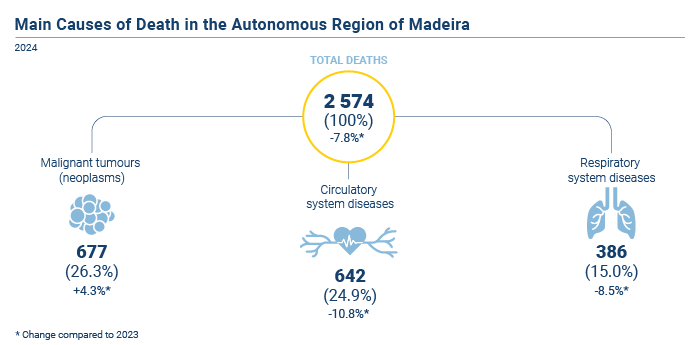
In 2024, there were 2 574 deaths among residents in the ARM, representing a decrease of 7.8% compared to 2023 (2 791 deaths). Of these, 1 206 were male (46.9%) and 1 368 were female (53.1%). The masculinity ratio at death was therefore 88.2, meaning that 88.2 male deaths were recorded for every 100 female deaths. At the national level, this ratio stood at 99.8.
During the reference year, the crude death rate in the ARM was 997.5 deaths per 100 000 inhabitants (1 107.1 nationally), with the female mortality rate (1 006.3) exceeding that of males (987.7).
Malignant neoplasms were the leading cause of death among residents of the ARM, with 677 deaths recorded (+4.3% compared to 2023), corresponding to a mortality rate of 262.4 deaths per 100 000 inhabitants (254.2 in 2023). Within this group, malignant neoplasm of colon, rectum and anus was the most frequent cause (92 deaths; 35.7 per 100 000 inhabitants), followed by malignant neoplasm of trachea, bronchus and lung (86 deaths; 33.3 per 100 000 inhabitants).
Circulatory system diseases were the second most frequent underlying cause of death, with 642 deaths (-10.8% compared to 2023), corresponding to a mortality rate of 248.8 deaths per 100 000 inhabitants (282.0 in 2023).
Respiratory system diseases were the third leading cause of death, with 386 deaths recorded in the Region (-8.5% compared to 2023), corresponding to a mortality rate of 149.6 per 100 000 inhabitants (165.3 in 2023).
In 2024, 21 deaths due to COVID-19 were recorded in the Region, 20 fewer than in 2023, corresponding to a mortality rate of 8.1 deaths per 100 000 inhabitants.
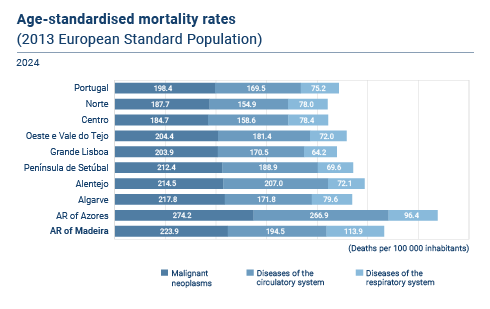
In comparative terms, using age-standardised mortality rates — an indicator that removes the effect of changes in the population’s age structure — the ARM recorded, in 2024, a value higher than the national figure: 940.1 deaths per 100 000 inhabitants, compared with 863.9 in Portugal.
Among the nine NUTS 2 regions, the ARM recorded the third highest rate, behind only the Autonomous Region of Azores (ARA) (1 161.9) and Alentejo (1 011.6). Área Metropolitana de Lisboa recorded the lowest rate, at 820.3 deaths per 100 000 inhabitants.
With regard to sex, the age-standardised mortality rate for women in the ARM stood at 770.8 deaths per 100 000 inhabitants, significantly lower than that of men (1 189.4). Although regional rates were higher, the difference between sexes remained similar to that observed at the national level, where women recorded 691.0 deaths per 100 000 inhabitants and men 1 093.5.
Regarding the three main causes of death mentioned above, the age-standardised mortality rates for malignant neoplasms and circulatory system diseases reached their highest values in the ARA, at 274.2 and 266.9 deaths per 100 000 inhabitants, respectively. For malignant neoplasms, the ARM recorded the second highest rate (223.9), above the national average (198.4). In mortality due to circulatory system diseases, the ARM recorded the third highest regional rate (194.5), after Alentejo (207.0) and above the national figure (169.5). Concerning mortality from respiratory system diseases, the ARM recorded the highest rate (113.9), followed by the ARA (96.4) and Algarve (79.6). For all these causes of death and across all regions, the age-standardised mortality rate was consistently higher among men.
By age group, 6 infant deaths (under 1 year of age) were recorded, corresponding to an infant mortality rate of 3.3‰. The main cause of death among these children was identified as certain conditions originating in the perinatal period (4 deaths).
In the group of children aged 1 to 14 years, 3 deaths were recorded: 2 due to malignant neoplasms and 1 due to endocrine, nutritional and metabolic diseases. The mortality rate in this group was 10.2 deaths per 100 000 inhabitants.
Among young persons aged 15 to 24 years, there were 9 deaths (31.2 per 100 000 inhabitants): 6 due to external causes of death, 1 due to circulatory system diseases, 1 due to respiratory system diseases and 1 due to symptoms, signs and abnormal clinical and laboratory findings, not elsewhere classified.
In the 25 to 64 years age group, 447 deaths were recorded (17.4% of total deaths; 311.3 per 100 000 inhabitants), with the leading causes being malignant neoplasms (186 deaths), circulatory system diseases (89 deaths) and external causes of death (51 deaths).
Among persons aged 65 to 84 years, 1 168 deaths were recorded (45.4% of the total; 2 439.3 per 100 000 inhabitants). In this group, the main cause of death continued to be malignant neoplasms (376 deaths), particularly malignant neoplasms of the colon, rectum and anus (54 deaths) and malignant neoplasms of the trachea, bronchus and lung (47 deaths). Circulatory system diseases ranked as the second leading cause of death (267 deaths), followed by respiratory system diseases (150 deaths).
In 2024, the Region recorded a total of 8 189 potential years of life lost (PYLL), corresponding to an average of 12.0 years per death occurring before the age of 70. Of these, 37.6% were due to malignant neoplasms (average of 10.9 years lost per death), 17.1% to circulatory system diseases (average of 10.4 years) and 16.2% to external causes of death (average of 20.0 years). At the national level, the average number of potential years of life lost was 12.4, higher than that recorded in the ARM.
For more information, please access:
International Statistical Cooperation
 |
International Statistical Cooperation
|
Statistical Literacy
 |
Statistical Literacy
|
|
|
|
|
 |
 |
|



 |
|
|
 |

Copyright © 2026 Direção Regional de Estatística da Madeira. All rights reserved.
Address: Calçada de Santa Clara 38, 9004-545 Funchal, Madeira Island
Phone: +351 291 145 110 (National landline call)