










Newsletters
Subscribe to our newsletter and get statistical data as soon as it is available!...
In 2025
Resident population of the Autonomous Region of Madeira exceeded 266 thousand, reaching the highest figure in the last fourteen years
The Regional Directorate of Statistics of Madeira (DREM) today releases the 2025 Resident Population Estimates, produced by Statistics Portugal (INE). These estimates are the first to be based entirely on administrative sources, encompassing the revision of the Resident Population Estimates for 2021 to 2024, calculated using the same methodology, for Portugal, NUTS 1, NUTS 2 and NUTS 3 (NUTS 2024) and Municipalities, as well as a set of derived demographic indicators.
The Annual Resident Population Estimates now released, starting in 2021, are based on the integration and use of data from administrative sources and on the application of residence-indicia methods. Up to 2020, the Annual Resident Population Estimates are final and based on previous population censuses, so the reading of the evolution from 2020 to 2021 should take this context into account.
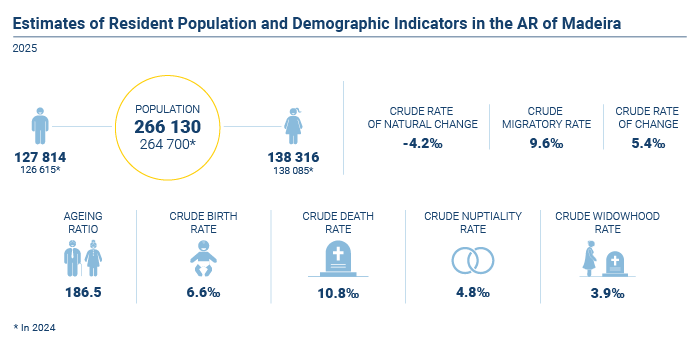
According to the data made available, on 31 December 2025, the resident population of the Autonomous Region of Madeira (ARM) was estimated at 266 130 persons (127 814 men and 138 316 women). The Region maintained, for the seventh consecutive year, its population growth trend, recording an increase of 1 430 persons compared with 2024 (264 700 persons, 126 615 men and 138 085 women). It should be noted that this population total is the highest in the last fourteen years, approaching the maximum recorded in 2010 (267 965 residents).
The migratory balance recorded in 2025 (+2 557), corresponding to the difference between persons who came from outside to reside in the Region and those who left, ceasing to be residents, was decisive for the increase in the resident population this year. This balance offset the unfavourable trend in the natural balance (difference between live births and deaths), which worsened compared with 2024, moving from −781 to −1 127.
The rate of effective growth (which combines the migratory effect with the natural effect) was positive, at +5.4‰ (+16.0‰ in 2024). This rate was driven mainly by the positive value of the migratory growth rate (+9.6‰), which outweighed the negative natural growth rate (−4.2‰).
The largest relative population increases were observed in the municipalities of Porto Santo (54.5‰), Porto Moniz (34.3‰) and Machico (14.7‰). It should be noted that only the municipalities of Santana (−1.7‰) and Funchal (−1.5‰) recorded negative rates of effective growth.
In 2025, the population density of the ARM was 332.2 inhabitants per km². Funchal was the municipality with the highest value (1 488.4 inhabitants/km²), contrasting with Porto Moniz, which had the lowest value (33.3 inhabitants/km²).
The proportion of young persons (population under 15 years of age) decreased again in 2025, representing 11.7% of the total population (12.1% in 2024). The proportion of elderly persons (population aged 65 or over) maintained the growing trend of recent years, reaching 21.9% of the resident population (21.3% in 2024). As a result, the ageing index, which relates the number of elderly persons to every 100 young persons, increased again, standing at 186.5 elderly persons for every 100 young persons (176.4 in 2024). The highest values for this indicator were recorded in Porto Moniz (310.5) and Santana (306.2).
The lowest values were observed in Santa Cruz (126.3) and Câmara de Lobos (122.3), with the number of elderly persons exceeding the number of young persons in all municipalities.
The median age of the Region's resident population, corresponding to the age that divides the population into two equally sized groups, rose from 46.8 years in 2024 to 47.2 years in 2025.
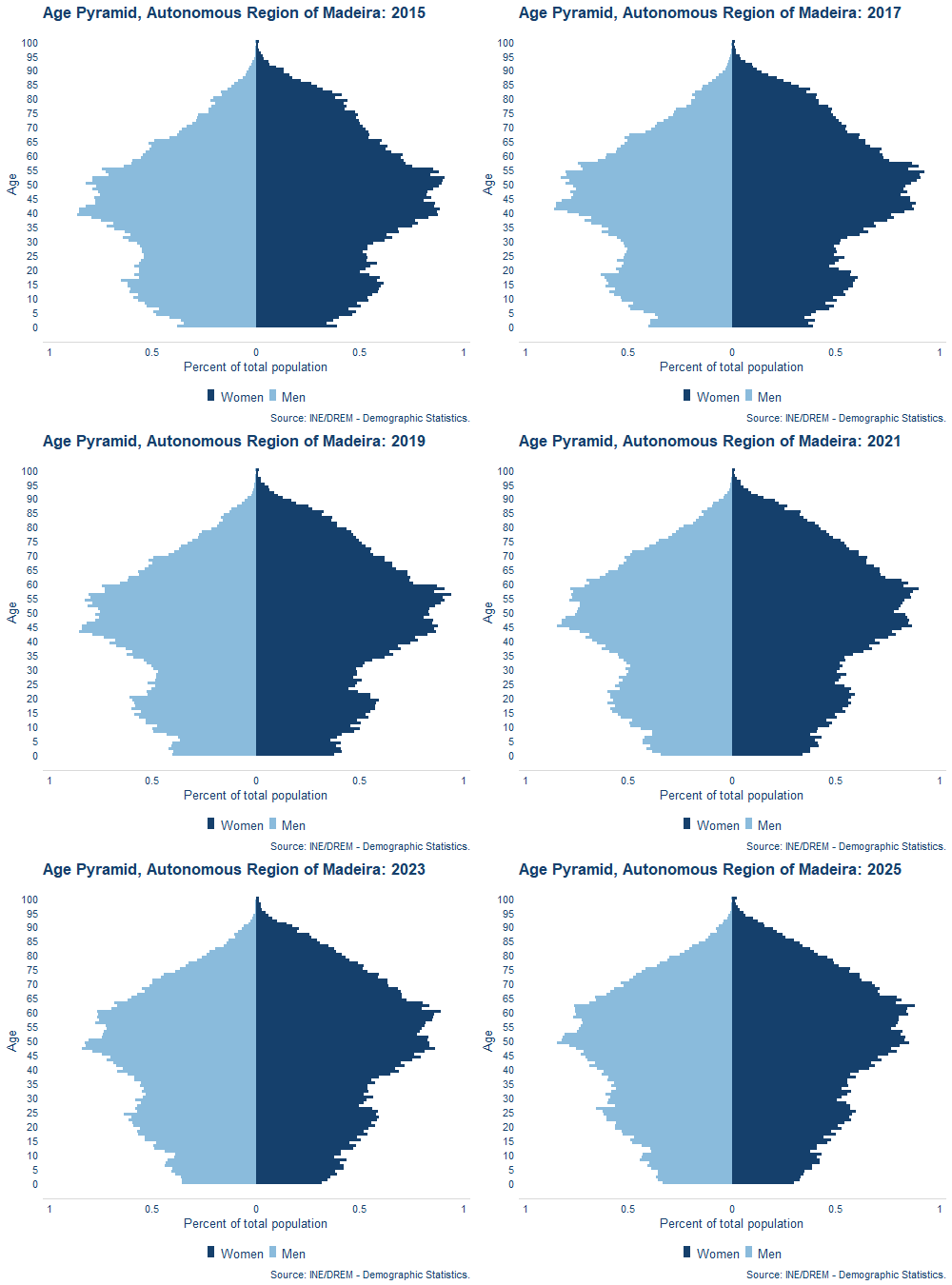
The trend of demographic ageing is reflected in the changing profile of the Region's age pyramids over the last decade (2015–2025). Indeed, on the one hand, the narrowing of the base of the pyramid can be observed, reflecting a reduction in population numbers due to declining birth rates, while on the other hand, the widening of the top of the pyramid reflects the increase in the number of elderly persons, related to rising life expectancy.
The average number of live children born per woman of childbearing age (15–49 years), expressed by the total fertility rate, decreased to 1.16 children per woman (1.20 in 2024), the lowest of all NUTS 2 regions, remaining considerably below the value required to ensure generational replacement (2.1 children per woman of childbearing age).
In 2025, there were 1 745 live births to mothers resident in the Region, 48 fewer children (−2.7%) than in 2024, corresponding to a crude birth rate of 6.6 live births per thousand inhabitants (6.8‰ in 2024).
In that year, there were 2 872 deaths of residents in the Region, 298 more deaths (+11.6%) than in 2024. The crude death rate stood at 10.8 per thousand inhabitants, higher than that observed in 2024 (9.8‰).
The number of marriages reached the highest figure in the last 18 years (1 286 marriages), reflected in a crude marriage rate of 4.8 marriages per thousand inhabitants in 2025 (4.7‰ in 2024).
In 2025, there were 1 028 marriages dissolved by the death of one spouse, 96 more than in the previous year (932). As a result, the crude widowhood rate reached 3.9 widowed persons per thousand inhabitants in 2025, increasing compared with 2024 (3.5 widowed persons per thousand inhabitants in 2024).
For more information, please click on:
International Statistical Cooperation
 |
International Statistical Cooperation
|
Statistical Literacy
 |
Statistical Literacy
|
|
|
|
|
 |
 |
|



 |
|
|
 |

Copyright © 2026 Direção Regional de Estatística da Madeira. All rights reserved.
Address: Calçada de Santa Clara 38, 9004-545 Funchal, Madeira Island
Phone: +351 291 145 110 (National landline call)