









Newsletters
Subscribe to our newsletter and get statistical data as soon as it is available!...
In the academic year 2022/2023
Gender parity among graduates in the region reached its highest level since the beginning of the available data series
During this academic year, the number of graduates from higher education institutions in the Region increased by 10.2%, resulting in a total of 874 graduates (up by 81 over the previous academic year). This figure represents the third highest since the beginning of the data series in 1993/1994, following 2007/2008 (1,004 graduates) and 2020/2021 (879 graduates). Of these, 524 diplomas were awarded in university-level education, making up 60.0% of the total, while 350 diplomas were conferred in polytechnic education, accounting for the remaining 40.0%.
The number of female graduates (464; 53.1% of the total) continues to surpass that of male graduates (410; 46.9%), although this academic year marked the closest parity between the percentages of female and male graduates since the beginning of the available data series. After a low of 19.0% in the proportion of male graduates in 2001/2002, this percentage has generally increased, albeit in a non-linear manner, reaching a peak of 46.9% in 2022/2023.
The age distribution of graduates continues to show a peak in the 20-24 age group, which accounted for 69.0% of the total graduates in the academic year under review (compared to 68.6% in 2021/2022). The 25-29 age group follows with 14.2% (14.1% in 2021/2022), while the 40 and over age group constitutes 7.8% (down from 9.3% in 2021/2022). In this academic year, there were 31.5 graduates per 1,000 inhabitants aged 20 to 29 years, a higher figure than that of the previous year.
It is evident that in the academic year 2022/2023, the number of graduates from public higher education institutions in the Region reached the second-highest value in the series, with 780 graduates (89.2% of the total, with the remaining 10.8% from private institutions). Only in the academic year 2007/2008, due to the implementation of the Bologna Process, was a higher number recorded, at 800 graduates, although this was proportionally lower (79.7%). Conversely, the number of graduates from private higher education establishments increased from 50 in 2021/2022 to 94 in 2022/2023.
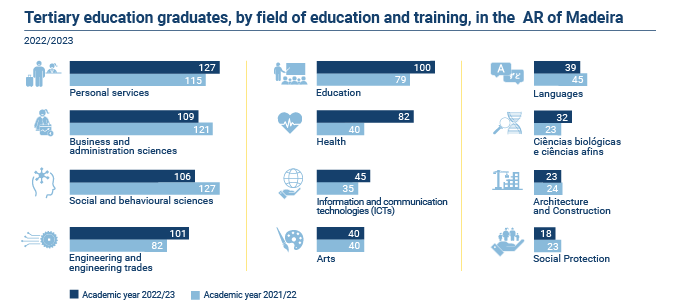
Regarding the distribution of graduates by fields of education and training in higher education in 2022/2023, five fields recorded a number of graduates in the hundreds. The field of "Personal Services" recorded the highest number of graduates (127; 14.5% of the total), followed by "Business and Administration Sciences" (109; 12.5%), "Social and Behavioural Sciences" (106; 12.1%), "Engineering and Related Technologies" (101; 11.6%), and "Education" (100; 11.4%). Courses in these five fields accounted for 62.1% of all higher education graduates in the academic year 2022/2023.
The distribution of diplomas by study cycles reveals a predominance of Bachelor's degrees at 64.6%, followed by Master's degrees at 12.8% and Doctoral degrees at 1.0%. Graduates from "Higher Professional Technical Courses" comprised 21.5% of the total number of graduates.
For more information, please click on:
International Statistical Cooperation
 |
International Statistical Cooperation
|
Statistical Literacy
 |
Statistical Literacy
|
|
|
|
|
 |
 |
|



 |
|
|
 |

Copyright © 2026 Direção Regional de Estatística da Madeira. All rights reserved.
Address: Calçada de Santa Clara 38, 9004-545 Funchal, Madeira Island
Phone: +351 291 145 110 (National landline call)