









Newsletters
Subscribe to our newsletter and get statistical data as soon as it is available!...
In the academic year 2023/2024
Disparity between the percentage of female and male graduates increased compared to the previous academic year
In the academic year 2023/2024, the number of graduates from higher education institutions in the Autonomous Region of Madeira (ARM) decreased by 1.4%, with a total of 862 diplomas awarded (-12 fewer than in the previous academic year). Of these, 565 diplomas (65.5%) were issued by universities and 297 (34.5%) by polytechnic institutions.
The number of female graduates (490; 56.8% of the total) continued to surpass that of male graduates (372; 43.2%). The gender gap widened when compared with the previous academic year, which had recorded the closest balance between the percentages of male and female graduates. Following a historical minimum of 19.0% for male graduates in 2001/2002, this proportion has shown a general upward trend—albeit non-linear—reaching a peak of 46.9% in 2022/2023, before declining once again in 2023/2024.
The age structure of graduates continued to exhibit a marked concentration in the 20–24 age group, which accounted for 64.6% of all graduates in the academic year under review (down from 69.0% in 2022/2023). This was followed by the 25–29 age group, representing 18.2% (up from 14.2% in 2022/2023), and the 40 and over age group, with 8.4% (up from 7.8% in 2022/2023). In 2023/2024, there were 30.0 graduates per 1 000 inhabitants aged 20 to 29, a figure lower than that recorded in the previous academic year (31.5 per thousand).
In 2023/2024, the number of graduates from public higher education institutions in the Region reached the third highest value in the time series, totalling 778 graduates (90.3% of the total, with the remaining 9.7% graduating from private institutions). Only two academic years recorded higher figures: 2007/2008, with 800 graduates, largely attributed to the implementation of the Bologna Process (although with a lower proportional share of 79.7%); and 2022/2023, with 780 graduates (89.2%). Conversely, the number of graduates from private higher education institutions decreased from 94 in 2022/2023 to 84 in 2023/2024.
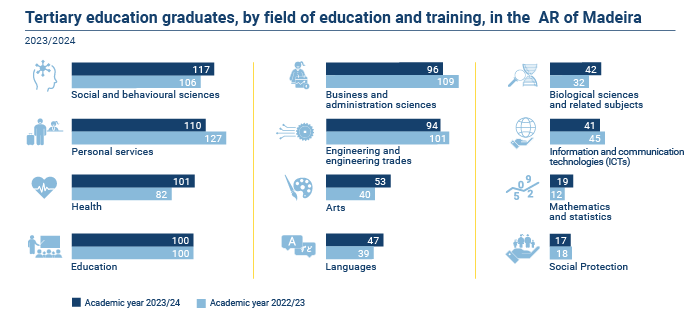
Regarding the distribution of graduates by education and training fields in higher education, in 2023/2024, four fields recorded graduate numbers in the hundreds. “Social and Behavioural Sciences” accounted for the highest number (117; 13.6% of the total), followed by “Personal Services” (110; 12.8%), “Health” (101; 11.7%), and “Education” (100; 11.6%). Together, these four fields represented 49.7% of all higher education graduates in the academic year 2023/2024.
The distribution of graduates by level of study reveals that 68.0% completed Bachelor’s degrees, 16.0% completed Master’s degrees, and 0.8% obtained Doctorates. Graduates from “Higher Professional Technical Courses” represented 15.2% of the total.
For more information, please click on:
International Statistical Cooperation
 |
International Statistical Cooperation
|
Statistical Literacy
 |
Statistical Literacy
|
|
|
|
|
 |
 |
|



 |
|
|
 |

Copyright © 2026 Direção Regional de Estatística da Madeira. All rights reserved.
Address: Calçada de Santa Clara 38, 9004-545 Funchal, Madeira Island
Phone: +351 291 145 110 (National landline call)