









Newsletters
Subscribe to our newsletter and get statistical data as soon as it is available!...
In the academic year 2023/2024
1st cycle of Primary Education registered the highest transition/completion rate
The Regional Directorate of Statistics of Madeira (DREM) has released the updated edition of the “Time Series of Education in the Autonomous Region of Madeira” incorporating data on non-tertiary education for the academic year 2023/2024. The data was provided by the Observatory of Education of the Autonomous Region of Madeira (OERAM), a core unit of the Regional Directorate of School Administration (DRAE) of the Regional Secretariat of Education, Science, and Technology.
In the 2023/2024 school year, within the scope of the 'Modular Training' offer, only trainees who obtained school certification are considered enrolled students, in accordance with the criteria adopted at the national level. Consequently, a break in the time series is noted in the total number of students enrolled in both the 2nd and 3rd cycles of Primary Education as well as in Upper Secondary Education.
In the academic year 2023/2024, the number of educational establishments of Pre-School and Upper Secondary Education increased, remaining the same as the previous academic year in the 1st and 2nd cycles of Primary Education and in Lower Secondary Education.
A total of 37 841 students were enrolled across all levels from Pre-School to Upper Secondary Education. In adult-oriented courses, there were 29 899 students from the 1st cycle of Primary Education to Secondary Education, a decrease of 373 students compared to the previous academic year (-1.2%).
Considering the institutional nature, public education accounted for 77.8% of registrations/enrollments, while private education accounted for 22.2%.
In turn, the number of students who participated in adult-oriented courses, which include recurrent education, Adult Education and Training courses (EFA), modular training and Recognition, Validation and Certification of Competences (RVCC), totalled 1 675 students. In particular, the number of adults who participated in EFA courses fell by 7.7% (-73 students) while the number of those in RVCC processes remained the same as in the previous academic year (182 students).
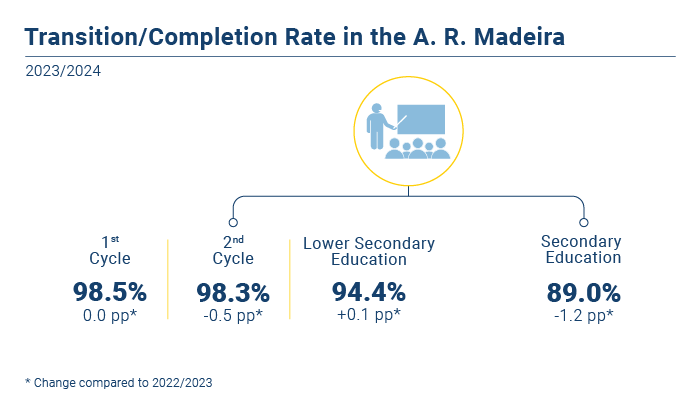
The transition/completion rate of 1st cycle of Primary Education was the highest, reaching 98.5%, the same value that was recorded in 2022/2023. In the 2nd Cycle, the rate was 98.3%, representing a decrease of 0.5 percentage points (pp). In the 3rd Cycle, a rate of 94.4% was recorded (+0.1 pp), whereas in Secondary Education the rate was 89.0%, representing a decrease of 1.2 pp.
In the academic year 2023/2024, there were 5 760 teachers in service, 53 fewer than in the previous academic year. Only in Pre-School Education and Vocational Schools did the proportion of teachers under 40 years of age exceed the proportion of teachers aged 60 or over. However, considering only public education, this scenario was observed exclusively in Vocational schools.
Of the total teachers, 5 115 belonged to public schools, with 92.1% integrated into the staff.
Non-teaching staff numbered 3 784, a decrease of 1.9% from the previous academic year.
For more information, please click on:
International Statistical Cooperation
 |
International Statistical Cooperation
|
Statistical Literacy
 |
Statistical Literacy
|
|
|
|
|
 |
 |
|



 |
|
|
 |

Copyright © 2026 Direção Regional de Estatística da Madeira. All rights reserved.
Address: Calçada de Santa Clara 38, 9004-545 Funchal, Madeira Island
Phone: +351 291 145 110 (National landline call)