











Subscribe to our newsletter and get statistical data as soon as it is available!...
|
Resident Population Resident Population Estimates (31 December) adjusted to the final results of the 2021 Census (thousands). |
|
2021 - 2024, Provisional Resident Population Estimates - post-census estimates based on the 2021 Census results. Source: Statistics Portugal/DREM - Demographic Statistics |
|
Unemployment Rate Quarterly rate obtained from the Labour Force Survey, corresponding to the ratio of the unemployed population to the active population (%). |
|
Source: Statistics Portugal/DREM - Labour Force Survey |
|
Inflation Rate Average Rate of Change over the last 12 months of the Consumer Price Index (%). |
|
Source: Statistics Portugal/DREM - Consumer Price Index |
|
Overnight Stays Overnight stays recorded in total collective tourist accommodation (thousands). |
|
Source: Statistics Portugal/DREM - Tourism Statistics |
|
GDP Gross Domestic Product (GDP) of the Autonomous Region of Madeira at current prices, base 2021 (million euros). |
|
The value for 2024 is provisional. Source: Statistics Portugal - Regional Accounts (Base 2021) |
|
Family Dwelling Sales Number of Family Dwelling Sales (Total, New and Existing) in the Autonomous Region of Madeira. |
|
Source: Statistics Portugal (INE, IP.). |
|
Company Incorporation and Dissolution Number of companies incorporated and dissolved. |
|
Source: Directorate-General for Justice Policy |
|
Natural Balance Difference between the number of live births and the number of deaths in a given period of time (No.). |
|
* Preliminary data compiled up to 10th April 2026. Source: Statistics Portugal/DREM - Demographic Statistics |
|
Regional Indicator of Economic Activity 3-month moving average (%). |
|
Source: DREM |
|
Population Resident Population estimates by the 31st of December which incorporate the 2021 Census final results (thousands). |
|
2021 - 2024, Provisional Resident Population Estimates, post-census estimates based on the results of the 2021 Census. Source: INE/DREM - Demographic Statistics |
|
Unemployment Rate Quarterly rate derived from the Labour Fource Survey, which corresponds to the ratio between the unemployed and the active population(%). |
|
Source: INE/DREM - Labour Force Survey |
|
Inflation Rate 12-month average growth rate of the Consumer Price Index. |
|
Source: INE/DREM - Consumer Price Index |
|
Overnight stays Overnight stays in tourism accommodation (thousands). |
|
Source: INE/DREM - Tourism Statistics |
|
GDP Gross Domestic Product (GDP) of the Autonomous Region of Madeira at current prices, base 2021 (millions of euros). |
|
The value for 2024 is provisional. Source: INE - Regional Accounts (Base 2021) |
|
Dwelling Sales Number of Dwelling Sales (Total, New e Existing), in the Autonomous Region of Madeira. |
|
Source: Statistics Portugal |
|
Formation and Dissolution of Companies Number of formed and dissolved companies. |
|
Source: Directorate-General for Justice Policy |
|
Natural Change Balance between the number of live births and the number of deaths in a given time period (No.). |
|
* Preliminary data compiled up until April 10th, 2026. Source: INE/DREM - Demographic Statistics |
|
Regional Indicator of Economic Activity 3-month moving average (%). |
|
Source: DREM |

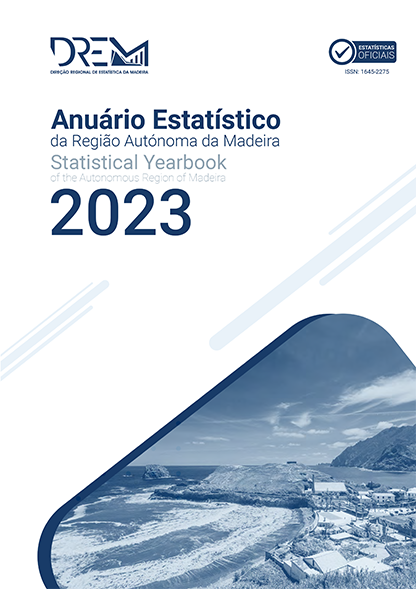
Annual publication
Price: papel - 3,50 € / PDF - Free
Year of publication: 2024
Reference period: 2023
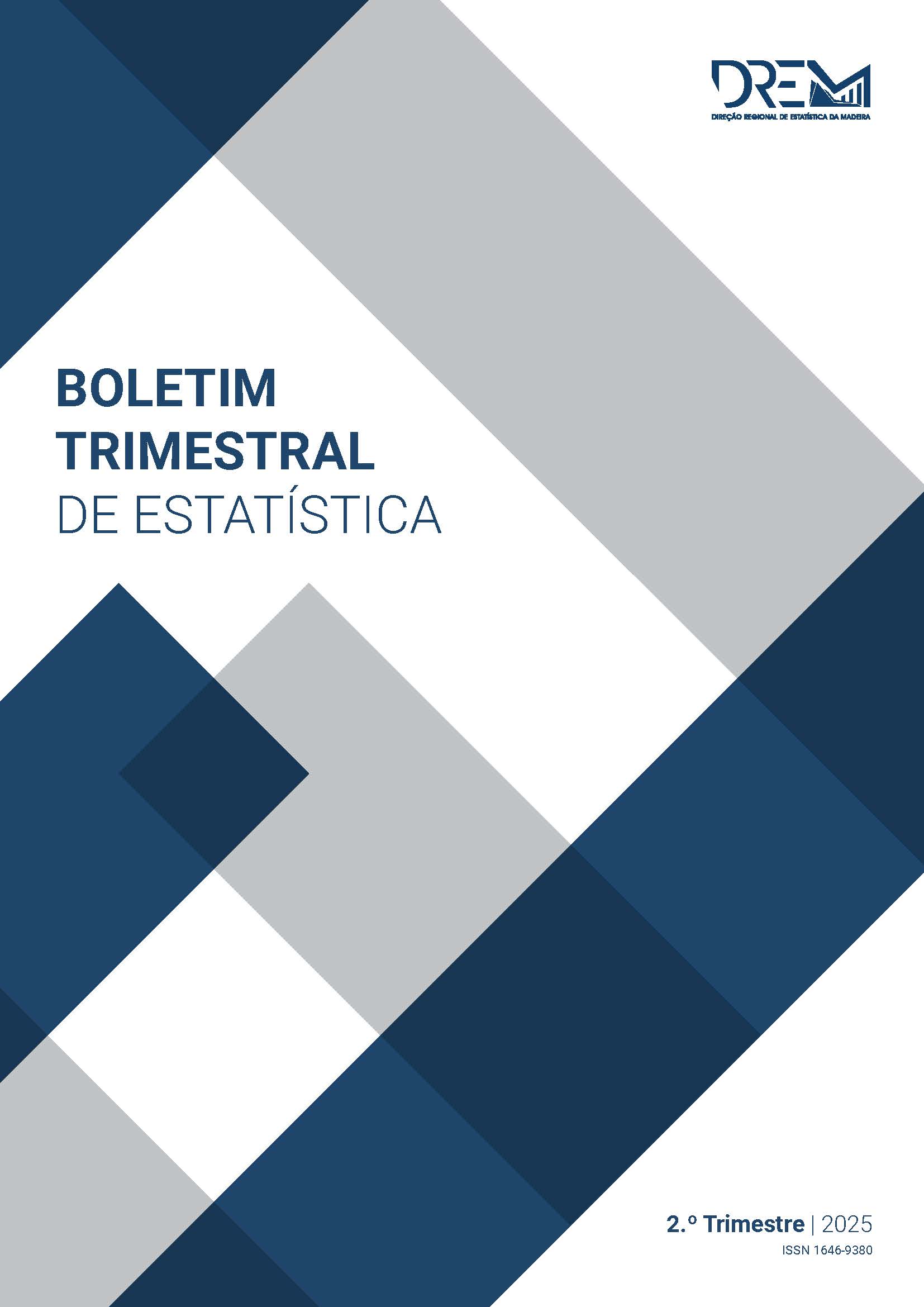
Quarterly Bulletin of Statistics
Quarterly publication
Price: paper - 4,00 € / PDF - Free
Year of publication: 2025
Reference period: 2nd Quarter 2025
Annual publication
Price: paper - 22,00 € / PDF - Free
Year of publication: 2024
Reference period: 2023

Census - Final results: Autonomous Region of Madeira - 2021
Annual publication
Price: paper - 10,00 € / PDF - Free
Year of publication: 2023
Reference period: 2021

Annual publication
Price: PDF - Free
Year of publication: 2026
Reference period: 2025
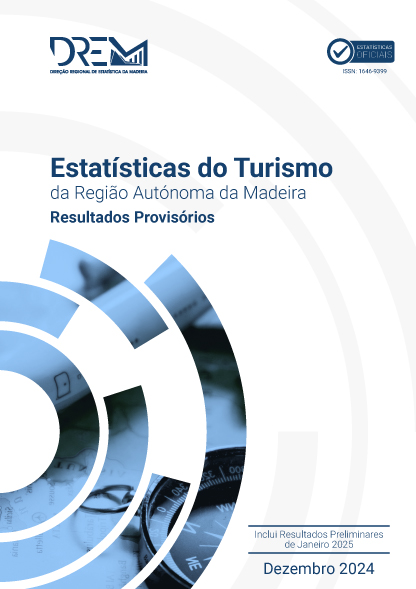
Monthly publication
Price: paper - 3,00 € / PDF - Free
Year of publication: 2025
Reference period: December 2024
Annual publication
Price: paper - 10,00 € / PDF - Free
Year of publication: 2024
Reference period: 2023

Annual publication
Price: paper- 12,00 € / PDF - Free
Year of publication: 2024
Reference period: 2022

International Trade Statistics
Annual publication
Price: paper- 6,00 € / PDF - Free
Year of publication: 2021
Reference period: 2020

Quarterly publication
Price: paper- 2,00 € / PDF - Free
Year of publication: 2025
Reference period: 4th Quarter 2024

Annual publication
Price: paper - 4,00 € / PDF - Free
Year of publication: 2024
Reference period: 2023

Agriculture and Fishery Statistics
Annual publication
Price: paper - 3,50 € / PDF - Free
Year of publication: 2024
Reference period: 2023

Annual publication
Price: paper - 12,00 € / PDF - Free
Year of publication: 2021
Reference period: 2019

Construction and Housing Statistics
Annual publication
Price: paper - 4,50 € / PDF - Free
Year of publication: 2024
Reference period: 2023
Annual publication
Price: paper - 3,50 € / PDF - Free
Year of publication: 2024
Reference period: 2023

Annual publication
Price: paper - 22,00 € / PDF - Free
Year of publication: 2023
Reference period: 2022

Monthly publication
Price: paper - 1,50 € / PDF - Free
Year of publication: 2025
Reference period: May 2025
Annual publication
Price: paper - 10,00 € / PDF - Free
Year of publication: 2024
Reference period: 2023
International Trade Statistics
Annual publication
Price: paper - 6,00 € / PDF - Free
Year of publication: 2021
Reference period: 2020
Annual publication
Price: paper - 4,00 € / PDF - Free
Year of publication: 2024
Reference period: 2023
Annual publication
Price: paper - 12,00 € / PDF - Free
Year of publication: 2021
Reference period: 2019
Quarterly Bulletin of Statistics
Quarterly publication
Price: paper - 4,00 € / PDF - Free
Year of publication: 2025
Reference period: 2nd Quarter 2025
Census - Final results. Autonomous Region of Madeira - 2021
Annual publication
Price: paper - 10,00 € / PDF - Free
Year of publication: 2023
Reference period: 2021
Construction and Housing Statistics
Annual publication
Price: paper - 4,50 € / PDF - Free
Year of publication: 2023
Reference period: 2022
Agriculture and Fishery Statistics
Annual publication
Price: paper - 3,50 € / PDF - Free
Year of publication: 2024
Reference period: 2023
Quarterly publication
Price: paper - 2,00 € / PDF - Free
Year of publication: 2025
Reference period: 4th Quarter 2024
Annual publication
Price: paper - 12,00 € / PDF - Free
Year of publication: 2024
Reference period: 2022
Monthly publication
Price: paper - 3,00 € / PDF - Free
Year of publication: 2025
Reference period: December 2024
DREM releases Education indicators resulting from the 2024 Labour Force Survey
As in previous years, the Regional Directorate of Statistics of Madeira (DREM) has released a set of education-related indicators for the Autonomous Region of Madeira, based on the 2024 Labour Force Survey (LFS).
Early school leavers rate continues to decline
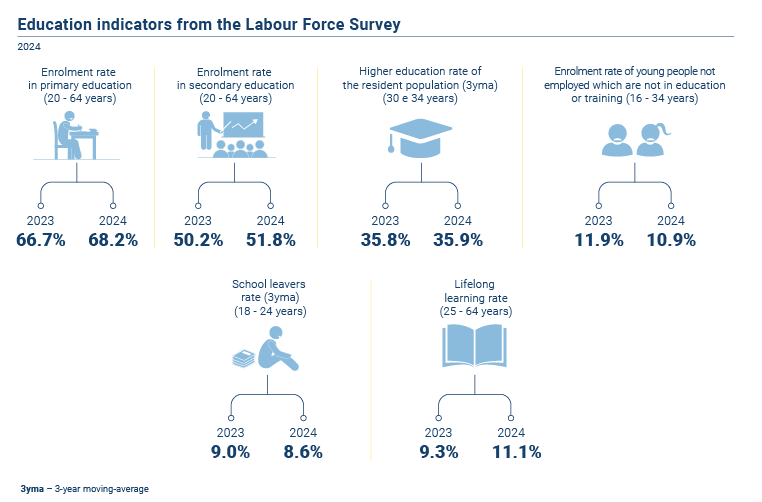
In the Autonomous Region of Madeira, the early school leavers rate for 2024 (expressed as a 3-year moving average, the only method that allows the release of this indicator for the ARM, according to the current dissemination criteria) stood at 8.6%, reflecting a decrease of 0.4 percentage points (pp) compared to the previous year. This indicator has been on a continuous downward trend since 2013, the first year of the time series, when it reached 28.2%. Although not in a linear manner, there is a trend towards convergence between the regional early school leavers rate and the national average, which stood at 7.0% as a 3-year moving average in 2024, reflecting a differential of 1.6 pp. In 2013, the regional rate exceeded the national rate by 7.5 pp. It is noteworthy that in 2024, in ARM, as in the previous years, this rate was higher for men (11.9%) than for women (5.1%). This gap reached 6.8 pp. Compared to the previous year, the rate decreased by 1.1 pp for men and increased by 0.2 pp for women. Compared to the beginning of the series, the decrease of 24.3 pp in the rate for men and 14.7 pp in the rate for women stands out.
Lifelong learning rate reaches the highest value in the time series
In 2024, the lifelong learning rate was 11.1%, the highest value in the series that began in 2011, with the rate being higher among women (12.8%) than men (9.2%). Compared to 2023, there was an increase of 1.8 pp. At the national level, in 2024, the lifelong learning rate stood at 16.1%, increasing by 2.8 pp compared to the previous year.
Schooling rates on the rise
The schooling rates for primary education level and secondary education level showed an upward trend between 2011 and 2024. For primary education, the indicator reflects the proportion of the resident population aged between 20 and 64 years who have completed at least the lower secondary education, within the total resident population of the same age group, having reached 68.2% in the last year (up from 48.2% in 2011 and 66.7% in 2023). Similarly, the schooling rate for secondary education, which represents the proportion of the resident population who have completed secondary education, in the total resident population aged between 20 and 64 years, increased to 51.8% (31.5% in 2011 and 50.2% in 2023). At the national level, the schooling rates in 2024 were 80.9% for primary (79.6% in 2023) and 64.0% for secondary education (61.4% in 2023).
Regarding the schooling rate for the tertiary education level of the resident population in the Autonomous Region of Madeira aged between 30 and 34 years (3-year moving average), it stood at 35.9% in 2024 (43.8% for women and 27.8% for men). Although this percentage was still below the national average (41.0%), it represents an increment of 8.7 pp compared to 2013 (the first year of the time series with a rate equal to 27.2%).
Percentage of youth not employed nor in education or training reaches minimum
In 2024, the percentage of young persons (16-34 years) not employed and not in education or training (NEET) stood at 10.9%, 1.0 pp lower compared to 2023, constituting the minimum value of the series that began in 2011. It is noteworthy that this indicator decreased by around 2.5 pp in the 25-34 age group. In the last year, the percentage of women between 16 and 34 years not in education or training (11.5%) was higher than that of men (10.2%), by 1.3 pp. The percentage of 10.9% NEET in 2024 corresponds to 5.7 thousand young persons, divided almost equally between inactive persons and unemployed persons.
At the national level, the NEET rate also declined between 2023 and 2024, from 9.7% in 2023 to 9.4% in 2024 (-0.3 pp). In the latter year, the NEET rate for women (9.9%) exceeded that of men (8.9%) by 1.0 pp. By age group, in 2024, the NEET rate for young persons aged between 25 and 34 years was 10.1% (10.6% in 2023).
For more information, please click on:
 |
|
 |
|





|
|
|
|
 |
 |
|
 |
|
|
 |
Copyright © 2026 Direção Regional de Estatística da Madeira. All rights reserved.
Address: Calçada de Santa Clara 38, 9004-545 Funchal, Madeira Island
Phone: +351 291 145 126 (National landline call)


