











Subscribe to our newsletter and get statistical data as soon as it is available!...
|
Resident Population Resident Population Estimates (31 December) adjusted to the final results of the 2021 Census (thousands). |
|
2021 - 2024, Provisional Resident Population Estimates - post-census estimates based on the 2021 Census results. Source: Statistics Portugal/DREM - Demographic Statistics |
|
Unemployment Rate Quarterly rate obtained from the Labour Force Survey, corresponding to the ratio of the unemployed population to the active population (%). |
|
Source: Statistics Portugal/DREM - Labour Force Survey |
|
Inflation Rate Average Rate of Change over the last 12 months of the Consumer Price Index (%). |
|
Source: Statistics Portugal/DREM - Consumer Price Index |
|
Overnight Stays Overnight stays recorded in total collective tourist accommodation (thousands). |
|
Source: Statistics Portugal/DREM - Tourism Statistics |
|
GDP Gross Domestic Product (GDP) of the Autonomous Region of Madeira at current prices, base 2021 (million euros). |
|
The value for 2024 is provisional. Source: Statistics Portugal - Regional Accounts (Base 2021) |
|
Family Dwelling Sales Number of Family Dwelling Sales (Total, New and Existing) in the Autonomous Region of Madeira. |
|
Source: Statistics Portugal (INE, IP.). |
|
Company Incorporation and Dissolution Number of companies incorporated and dissolved. |
|
Source: Directorate-General for Justice Policy |
|
Natural Balance Difference between the number of live births and the number of deaths in a given period of time (No.). |
|
* Preliminary data compiled up to 10th April 2026. Source: Statistics Portugal/DREM - Demographic Statistics |
|
Regional Indicator of Economic Activity 3-month moving average (%). |
|
Source: DREM |
|
Population Resident Population estimates by the 31st of December which incorporate the 2021 Census final results (thousands). |
|
2021 - 2024, Provisional Resident Population Estimates, post-census estimates based on the results of the 2021 Census. Source: INE/DREM - Demographic Statistics |
|
Unemployment Rate Quarterly rate derived from the Labour Fource Survey, which corresponds to the ratio between the unemployed and the active population(%). |
|
Source: INE/DREM - Labour Force Survey |
|
Inflation Rate 12-month average growth rate of the Consumer Price Index. |
|
Source: INE/DREM - Consumer Price Index |
|
Overnight stays Overnight stays in tourism accommodation (thousands). |
|
Source: INE/DREM - Tourism Statistics |
|
GDP Gross Domestic Product (GDP) of the Autonomous Region of Madeira at current prices, base 2021 (millions of euros). |
|
The value for 2024 is provisional. Source: INE - Regional Accounts (Base 2021) |
|
Dwelling Sales Number of Dwelling Sales (Total, New e Existing), in the Autonomous Region of Madeira. |
|
Source: Statistics Portugal |
|
Formation and Dissolution of Companies Number of formed and dissolved companies. |
|
Source: Directorate-General for Justice Policy |
|
Natural Change Balance between the number of live births and the number of deaths in a given time period (No.). |
|
* Preliminary data compiled up until April 10th, 2026. Source: INE/DREM - Demographic Statistics |
|
Regional Indicator of Economic Activity 3-month moving average (%). |
|
Source: DREM |

Annual publication
Price: papel - 3,50 € / PDF - Free
Year of publication: 2024
Reference period: 2023
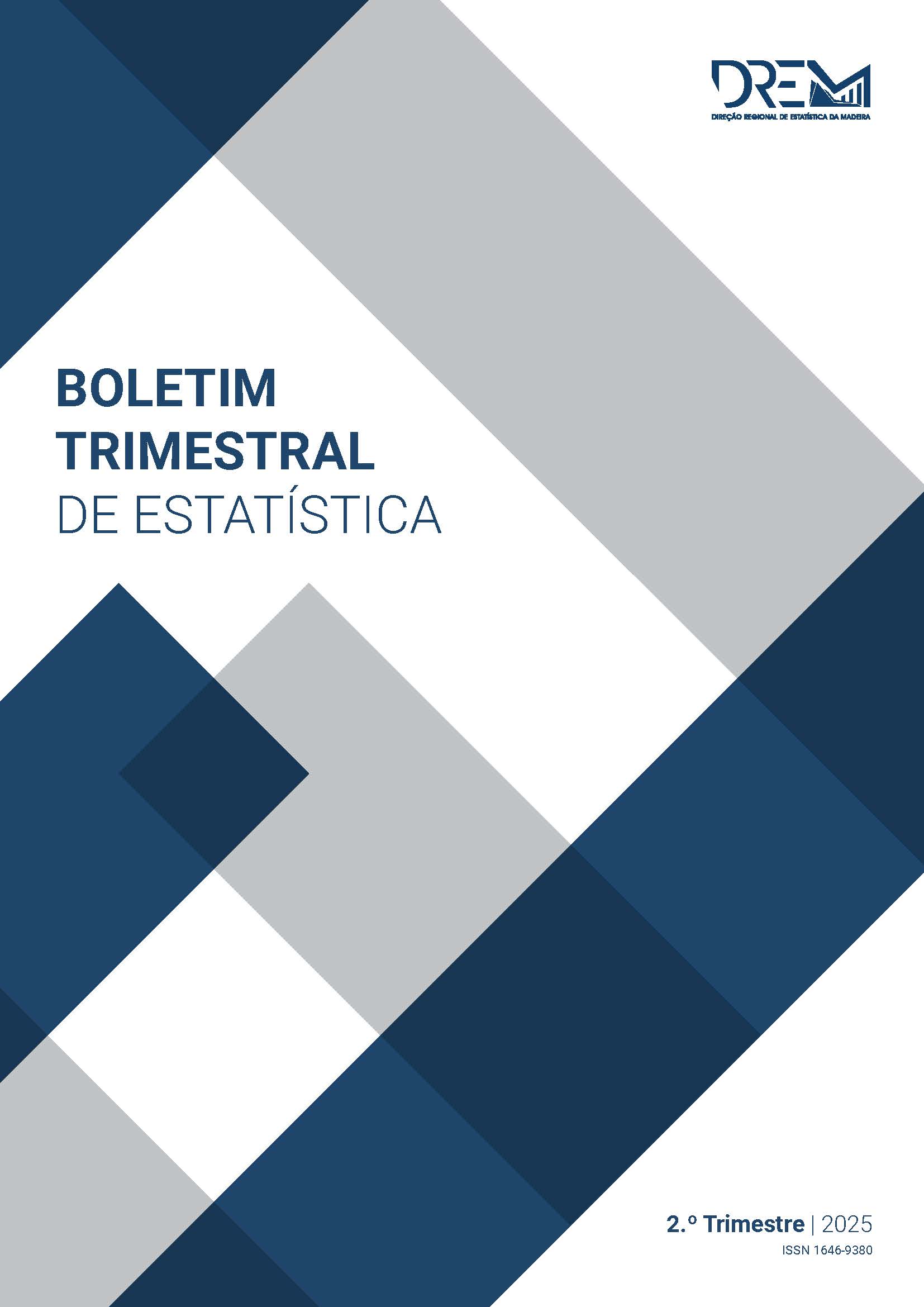
Quarterly Bulletin of Statistics
Quarterly publication
Price: paper - 4,00 € / PDF - Free
Year of publication: 2025
Reference period: 2nd Quarter 2025
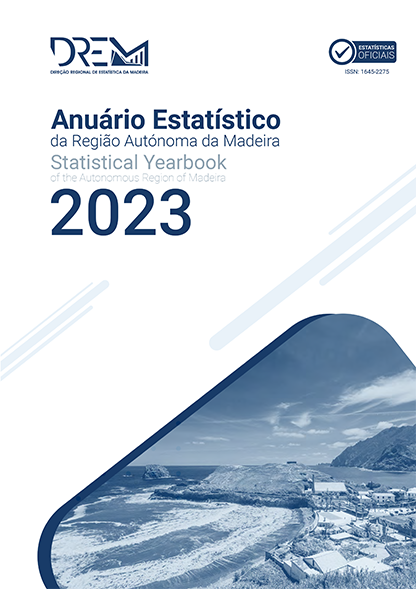
Annual publication
Price: paper - 22,00 € / PDF - Free
Year of publication: 2024
Reference period: 2023

Census - Final results: Autonomous Region of Madeira - 2021
Annual publication
Price: paper - 10,00 € / PDF - Free
Year of publication: 2023
Reference period: 2021

Annual publication
Price: PDF - Free
Year of publication: 2026
Reference period: 2025
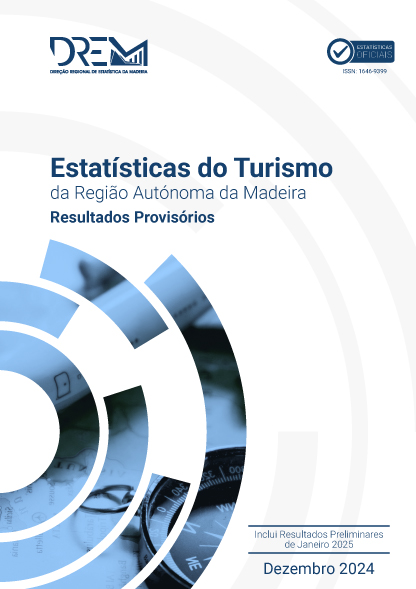
Monthly publication
Price: paper - 3,00 € / PDF - Free
Year of publication: 2025
Reference period: December 2024
Annual publication
Price: paper - 10,00 € / PDF - Free
Year of publication: 2024
Reference period: 2023

Annual publication
Price: paper- 12,00 € / PDF - Free
Year of publication: 2024
Reference period: 2022

International Trade Statistics
Annual publication
Price: paper- 6,00 € / PDF - Free
Year of publication: 2021
Reference period: 2020
Quarterly publication
Price: paper- 2,00 € / PDF - Free
Year of publication: 2025
Reference period: 4th Quarter 2024

Annual publication
Price: paper - 4,00 € / PDF - Free
Year of publication: 2024
Reference period: 2023

Agriculture and Fishery Statistics
Annual publication
Price: paper - 3,50 € / PDF - Free
Year of publication: 2024
Reference period: 2023

Annual publication
Price: paper - 12,00 € / PDF - Free
Year of publication: 2021
Reference period: 2019

Construction and Housing Statistics
Annual publication
Price: paper - 4,50 € / PDF - Free
Year of publication: 2024
Reference period: 2023
Annual publication
Price: paper - 3,50 € / PDF - Free
Year of publication: 2024
Reference period: 2023

Annual publication
Price: paper - 22,00 € / PDF - Free
Year of publication: 2023
Reference period: 2022

Monthly publication
Price: paper - 1,50 € / PDF - Free
Year of publication: 2025
Reference period: May 2025
Annual publication
Price: paper - 10,00 € / PDF - Free
Year of publication: 2024
Reference period: 2023
International Trade Statistics
Annual publication
Price: paper - 6,00 € / PDF - Free
Year of publication: 2021
Reference period: 2020
Annual publication
Price: paper - 4,00 € / PDF - Free
Year of publication: 2024
Reference period: 2023
Annual publication
Price: paper - 12,00 € / PDF - Free
Year of publication: 2021
Reference period: 2019
Quarterly Bulletin of Statistics
Quarterly publication
Price: paper - 4,00 € / PDF - Free
Year of publication: 2025
Reference period: 2nd Quarter 2025
Census - Final results. Autonomous Region of Madeira - 2021
Annual publication
Price: paper - 10,00 € / PDF - Free
Year of publication: 2023
Reference period: 2021
Construction and Housing Statistics
Annual publication
Price: paper - 4,50 € / PDF - Free
Year of publication: 2023
Reference period: 2022
Agriculture and Fishery Statistics
Annual publication
Price: paper - 3,50 € / PDF - Free
Year of publication: 2024
Reference period: 2023
Quarterly publication
Price: paper - 2,00 € / PDF - Free
Year of publication: 2025
Reference period: 4th Quarter 2024
Annual publication
Price: paper - 12,00 € / PDF - Free
Year of publication: 2024
Reference period: 2022
Monthly publication
Price: paper - 3,00 € / PDF - Free
Year of publication: 2025
Reference period: December 2024
DREM releases provisional results of the 2020 Survey on Income and Living Conditions
The Regional Directorate of Statistics of Madeira (DREM) conducts annually the Survey on Income and Living Conditions (EU-SILC) in the Autonomous Region of Madeira, under the guidance of Statistics Portugal (INE), since EU-SILC is a statistical operation of national scope.
It is also a harmonised statistical operation in the European Union, carried out within the framework of specific EU legislation (Regulation (EC) No 1177/2003) and it aims to produce statistics on the distribution of income, living conditions and social exclusion, allowing the analysis of:
In this context, DREM releases today, on its website, some provisional results of EU-SILC, carried out between March and September 2020, on previous year incomes. As a result of the public health measures related to the COVID-19 pandemic, namely confinement and social detachment, the survey conducted in 2020 was carried out exclusively through telephone interviews (CATI, or Computer Assisted Telephone Interviewing), the size of the annual subsample was increased and the collection period was extended until September.
Median equivalised disposable income in the Autonomous Region of Madeira stood at EUR 9,045
The median equivalised income in the Autonomous Region of Madeira was EUR 9,045, below the national value, which was EUR 10,800.
At-risk-of-poverty rate in 2019 was 26.3%
The national at-risk-of-poverty threshold (which corresponds to 60% of median equivalised income) stood at EUR 6,480, while the regional at-risk-of-poverty threshold for the Autonomous Region of Madeira was EUR 5,427.
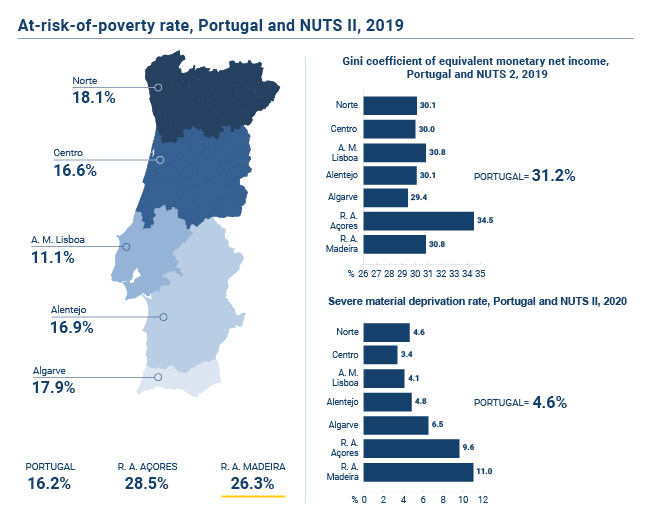
The at-risk-of-poverty rate (calculated with the national at-risk-of-poverty threshold) in the country dropped from 17.2% in 2018 to 16.2% in 2019, while in the Autonomous Region of Madeira it decreased by 1.5 percentage points (p.p.) to 26.3%. Área Metropolitana de Lisboa had the lowest value (11.1%) and the Autonomous Region of Azores, the highest (28.5%).
The at-risk-of-poverty rate (calculated with the regional at-risk-of-poverty thresholds) indicates that the Autonomous Region of Madeira and Azores have the highest values (17.3% and 20.4%). Alentejo (14.7%) had the lowest value.
Very low work intensity in the Autonomous Region of Madeira maintained its decreasing tendency in 2019
Persons in a very low work intensity condition are those aged less than 60 who, in the income reference period, lived in households where adults aged 18-59 (excluding students) worked on average less than 20% of the labour potential. This situation can enhance the risk of social exclusion of a household.
In 2019, the proportion of population under 60 years old living in households with very low work intensity stood at 9.2%, dropping by 0.2 p.p. from 2018. The highest value was registered in the Autonomous Region of Madeira and the lowest in Centro (3.9%). The national average was 5.1%, recording a 1.1 p.p. decline.
Severe material deprivation rate in the Region increases to 11.0%
Material deprivation, i.e., the lack of access to a set of economic needs and durable goods, is also a factor that can enhance the risk of social exclusion.
If there is an enforced lack of at least four out of the following nine items, due to economic difficulties, there is a case of severe material deprivation : a) capacity to face unexpected financial expenses (without asking for financial help); b) capacity to afford paying for one week's annual holiday away from home, paying travel and accommodation costs for all household members; c) capacity to pay on time for mortgage or rent payments, utility bills, hire purchase installments or other loan payments; d) capacity to afford a meal with meat, chicken, fish (or vegetarian equivalent) every second day; e) capacity to pay for keeping its home adequately warm; f) capacity to afford for a washing machine; g) capacity to afford for a color TV; h) capacity to afford for a telephone (including a mobile phone); i) capacity to afford a car.
In 2020, in the Autonomous Region of Madeira, the severe material deprivation rate is 11.0%, increasing by 3.7 p.p. from the previous year. The Autonomous Region of Madeira had the highest value and Centro (3.4%) the lowest. The national average was 4.6%, decreasing by 1.0 p.p. from the previous year.
At-risk-of poverty or social exclusion rate in the Autonomous Region of Madeira in 2019 was 32.9%
In the context of Europe 2020, an indicator was set out regarding the population at-risk-of-poverty or social exclusion, joining the concepts of relative at-risk-of-poverty rate – people with an annual equivalent income below the poverty threshold – and severe material deprivation with the concept of very low per capita labour intensity.
In 2020, in the Autonomous Region of Madeira, the at-risk-of poverty or social exclusion rate was 32.9%, increasing 0.7 p.p. from 2019. The Autonomous Region of Madeira had the highest rate, flowed by the Autonomous Region of Azores (32.4%), while the Área Metropolitana de Lisboa had the lowest rate (14.6%). The country’s rate was 19.8%, meaning that 2,037 thousand persons in Portugal were in at-risk-of-poverty or social exclusion. Compared to 2019, this indicator dropped 1.8 p.p.
Inequality in income distribution in the Region dropped in 2019 and is now below the national average
Two indicators – the Gini coefficient and the S80 / S20 ratio - make it possible to assess asymmetry in income distribution in the Autonomous Region of Madeira and in the country.
The Gini coefficient synthesizes into a single value the asymmetry of the income distribution, assuming values between 0 (when all individuals have the same income) and 100 (when the total income is concentrated in a single individual). In the Autonomous Region of Madeira, this indicator had the value of 30.8%, below the national value (31.2%). The Autonomous Region of Azores had the highest inequality 34.5%) and Algarve the lowest (29.4%).
For more information, please click on:
 |
|
 |
|





|
|
|
|
 |
 |
|
 |
|
|
 |
Copyright © 2026 Direção Regional de Estatística da Madeira. All rights reserved.
Address: Calçada de Santa Clara 38, 9004-545 Funchal, Madeira Island
Phone: +351 291 145 126 (National landline call)


